Arabic & English Websites in Qatar: Bilingual UX, RTL & SEO Guide
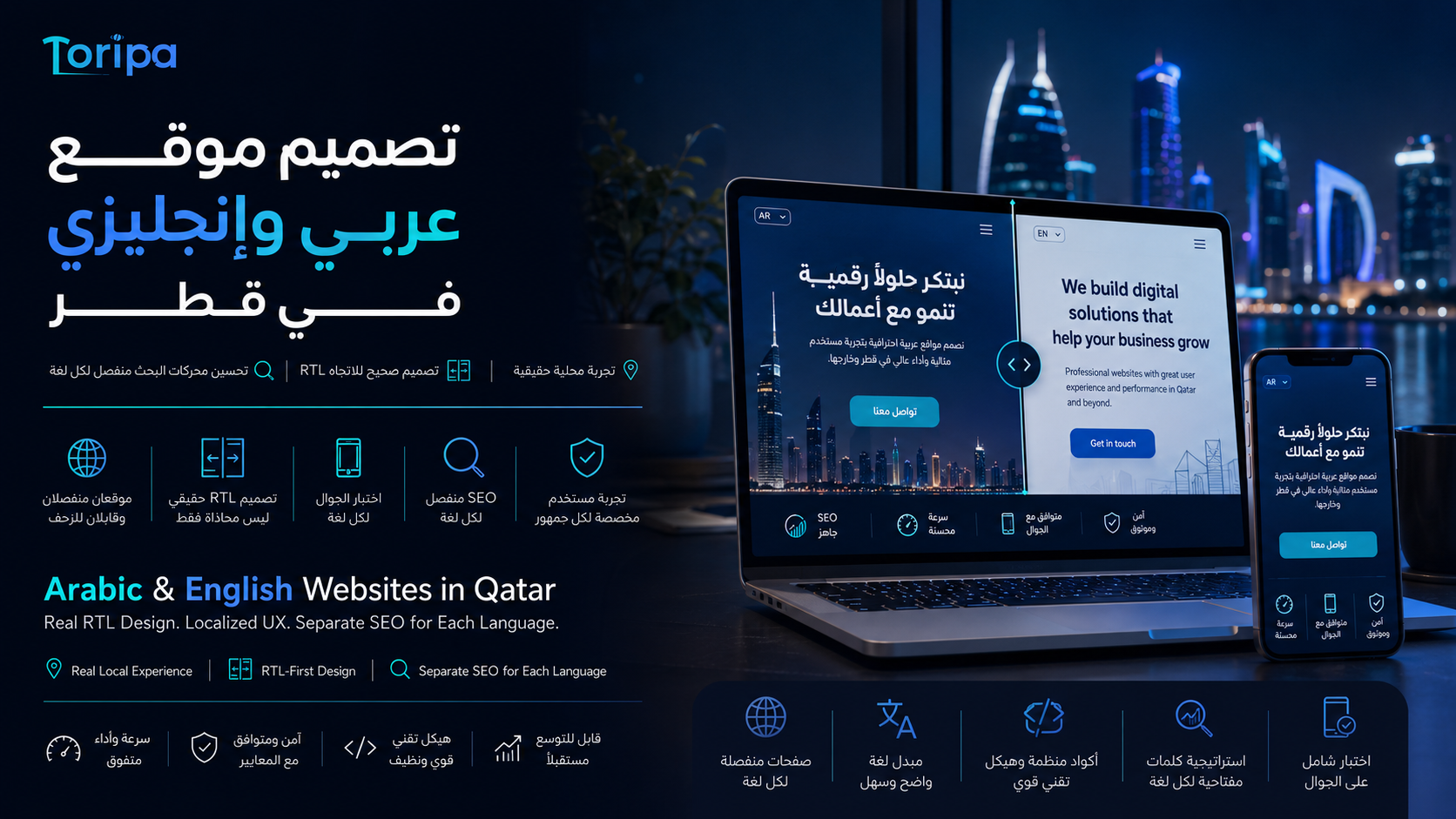
Bilingual Website Guide for Qatar — 2026
Arabic & English Websites in Qatar: Bilingual UX, RTL and SEO Done Properly
A bilingual website in Qatar should not feel like an English website with Arabic text poured into the same boxes. Arabic changes reading direction, layout behavior, typography, content length, search terms and often the persuasion itself. If the Arabic version looks like the neglected copy of the English site, customers notice immediately.
With Custom Website Development, the business requirement comes before the theme or platform. That matters for bilingual work: if a section needs to mirror, a form needs different wording, Arabic needs a different CTA, or the two language journeys should not be identical, the application can be scoped around that decision rather than forcing the requirement into a preset template.
Two real experiences
Arabic and English should each read naturally, use the right search language and preserve the same business promise without forcing identical copy.
RTL is structural
Right-to-left support affects layout, spacing, icon direction, navigation and mixed-direction content. It is more than right-aligning a paragraph.
Two search markets
Arabic and English searchers can phrase the same need differently. Metadata, headings and content should be researched and optimized independently.
What should a bilingual website in Qatar actually include?
The minimum standard is not “there is an AR button.” A professional Arabic and English website should let a visitor complete the same meaningful task in either language: understand the offer, evaluate services, trust the company, submit an inquiry, book, buy or contact the team without being pushed back into English halfway through.
Translation is content. RTL is engineering.
Arabic is a right-to-left language. The W3C recommends declaring direction structurally with the HTML dir attribute rather than relying on CSS alone. A robust bilingual interface then uses direction-aware layout rules so spacing, alignment and component order can adapt predictably. The important detail is that not everything should be blindly mirrored: phone numbers, email addresses, Latin product codes and mixed Arabic/English strings are bidirectional content and need testing.
This is one reason a “duplicate page + translate text” workflow can break. Cards overflow because Arabic copy is longer, arrows point the wrong way, sliders move against the reading direction, form fields become awkward and navigation looks visually unbalanced. These are development issues, not translation issues.
W3C guidance on right-to-left text in HTMLBilingual SEO: Arabic keywords are not English keywords translated word for word
The Arabic page should be optimized around how Arabic-speaking customers express the problem. The English page should do the same for English-speaking customers. For example, an English service page targeting “website development Qatar” does not become an Arabic search page simply by translating the visible paragraph; the Arabic version needs Arabic query research such as “تطوير المواقع في قطر”, “تصميم مواقع قطر” and the commercial variations that real users type.
Google also recommends explicitly identifying localized versions of pages. For a well-structured Qatar bilingual site, that normally means separate crawlable URLs and reciprocal hreflang annotations such as ar-QA and en-QA when those locale targets match the implementation. Google says each language version should reference itself and its alternatives, and missing return links can cause annotations to be ignored.
If your current bilingual site already exists but has indexing, metadata, canonical, performance or language-targeting problems, the right project may be Technical SEO & Performance Optimization rather than a full rebuild.
What does an Arabic & English website cost in Qatar?
Public offers are all over the market because they sell very different products. A one-page hosted site, a WordPress package, a custom multi-page build and a corporate bilingual platform are not comparable just because they all contain Arabic and English.
| Provider / reference | Public price | What the public page says | Why scope matters |
|---|---|---|---|
| Digital Doha | QAR 99 one-time | One-page website, Arabic + English, domain/hosting and basic SEO; advertises 24-hour delivery. | Extremely cheap, but it is explicitly a focused one-page product rather than a custom multi-page business platform. |
| ScrollJuice Doha | From QAR 190/month | Hosted subscription model with Arabic + English and no heavy upfront payment. | A recurring hosted service is commercially different from buying a custom-developed website project. |
| Qatar Website Design / NetSoft | From QAR 1,500 | Its small-business package publicly lists WordPress, responsive design, bilingual Arabic/English and an SEO-friendly structure. | This is one of the closest public low-cost benchmarks, but the implementation is WordPress and its own page describes Qatar delivery as remote via its Dubai/North America teams. |
| Digipeak market guide | QAR 25,000–75,000 estimate | Publishes this range for a professional corporate website with custom design, bilingual AR/EN, CMS, on-page SEO and analytics. | This is one agency's published market estimate, not a Qatar-wide average or a like-for-like quote. |
| Toripa Tech | Starting from QAR 1,500 | Custom multi-page website development in Qatar for businesses that need a complete, professional online presence built for speed, SEO, mobile users, and long-term growth. | The final bilingual quote depends on language scope and the rest of the requirements; the starting point is not a promise that every two-language project costs the minimum. |
The aggressive part of our offer is not claiming that QAR 99 and QAR 25,000 buy the same thing. They obviously do not. It is that Custom Website Development currently Starting from QAR 1,500, and we compete for projects where businesses might otherwise assume they must choose between a cheap template/subscription and a much more expensive custom agency. The bilingual scope is priced according to what actually needs to be designed, written and built.
Why custom development changes the bilingual tradeoff
WordPress, WPML, Polylang and multilingual themes can absolutely produce good bilingual websites. We do not need to pretend otherwise. The tradeoff is that the behavior of your language system is partly shaped by the theme, plugin ecosystem and CMS model you selected.
With purpose-built development, we can model the languages around the business: paired routes, locale-aware content, custom language switching, RTL/LTR components, different content lengths, separate CTAs, localized structured data and any workflow the project genuinely requires. If an unusual request is technically feasible and compatible with third-party/legal constraints, the answer should be “let us scope it,” not “our theme cannot do that.”
Mobile is where bad RTL implementation becomes obvious
Desktop can hide weak localization because there is room for oversized headings and awkward controls. Mobile exposes it: translated labels wrap, menus collide, floating WhatsApp buttons cover Arabic text, carousels move the wrong way and two-column designs collapse in an order that no longer makes sense.
Test real Arabic copy on real breakpoints early. Do not approve an English mobile design and assume the Arabic version will “just mirror.” It should be part of the design system from the beginning.
The bilingual website checklist we would use before launch
Cheap enough to compete remotely, local enough to sit with you in Qatar
Remote development can be excellent. The problem is when a Qatar business is forced to choose between low pricing abroad and a large premium for someone who can actually sit down locally, review the Arabic experience and understand how the business operates here. Qatar-based team available for in-person project meetings. Our goal is to remove as much of that tradeoff as possible while we are building our market position.
The economic promise is simple: we intentionally keep our launch pricing aggressive and accept unusually low margins relative to the amount of custom work we deliver. That is a growth decision on our side, not permission to reduce the quality of the website on yours.
How Toripa Tech approaches the project
The current service process is:
- 1
Understand your business, audience, services, and goals
- 2
Plan the website structure, navigation, and core pages
- 3
Design the website, review the direction with you, and refine it based on feedback
- 4
Develop the agreed design and required functionality
- 5
Optimize performance, mobile experience, and SEO foundations
- 6
Test, launch, and support the website after deployment
For bilingual work, language decisions start during structure and design—not at the end after the English site has already been approved. That gives us time to identify where Arabic needs different copy, spacing, component behavior or search targeting before those decisions become expensive rework.
What to ask any bilingual website developer before signing
Frequently asked questions
How much does an Arabic and English website cost in Qatar?
There is no honest bilingual flat rate because the cost depends on page count, whether both languages need original content or translation, design complexity, CMS requirements, integrations and SEO scope. Custom Website Development currently Starting from QAR 1,500; The starting price is intended for a custom multi-page business website. Final pricing scales with page count, Arabic/English bilingual scope, service pages, blog/content requirements, contact forms, SEO content, integrations, and the amount of custom design iteration.
Does a bilingual Qatar website need separate Arabic and English URLs?
For search visibility, separate crawlable URLs for each language are usually the cleanest approach. Google recommends explicitly identifying localized versions and supports hreflang annotations so the appropriate language or regional version can be shown to users.
Is translating the English website enough for Arabic users?
Usually not. Arabic needs proper right-to-left layout, suitable typography, localized calls to action, natural Arabic wording, correctly handled mixed Arabic/English content, and keyword research based on how Arabic-speaking customers actually search rather than literal translations of English phrases.
What does RTL mean in Arabic web design?
RTL means right-to-left. Arabic interfaces should use the correct document direction and layouts that adapt naturally: text alignment, navigation flow, directional icons, spacing and component order may need to mirror, while items such as phone numbers, email addresses, code and some controls still need careful bidirectional handling.
Can WordPress build a good Arabic and English website?
Yes. WordPress can support multilingual sites well when the theme, translation setup and plugins are implemented carefully. The tradeoff is additional plugin and theme dependencies. Custom development can make language routing, RTL behavior and component-level control part of the application architecture instead.
Will Arabic and English pages rank for the same keywords?
Not necessarily, and they should not be treated as literal keyword mirrors. Search behavior differs by language. Arabic pages should target Arabic queries naturally, English pages should target English queries, and both should satisfy the same underlying business intent where appropriate.
Does Toripa Tech build bilingual websites in Qatar?
Yes. Custom multi-page website development in Qatar for businesses that need a complete, professional online presence built for speed, SEO, mobile users, and long-term growth. Bilingual scope is quoted according to the project requirements rather than forced into a fixed language add-on. Qatar-based team available for in-person project meetings.
Can Toripa Tech customize the Arabic and English experiences separately?
Yes, when the project needs it. We do not require the two versions to be pixel-for-pixel translations. Navigation labels, content length, calls to action, layouts, forms and even selected user journeys can be adapted when that creates a better experience. Real constraints such as third-party systems, legal requirements and project scope are discussed explicitly.
Methodology and source note
Technical guidance was checked against Google Search Central and W3C internationalization documentation. Public Qatar-facing pricing and scope references were reviewed on 27 August 2026. Competitor products are not identical, so the figures above are evidence of available public offers—not a claim that every provider is quoting the same project.
Still defining the broader project? Start with the website development in Qatar guide for scope, pricing, technology, ownership and timeline decisions.
Do not pay a premium just because your Qatar website needs Arabic
Send us the pages, required languages, functionality and examples you like. We will scope the bilingual experience around what the business actually needs and explain where the work is simple, where it is genuinely custom and what changes the price. Free consultation and quote with no obligation.
Discuss your Arabic & English websiteReady to Grow Your Business Online?
Let's discuss how we can help you build a powerful online presence that attracts customers and drives results.
Get in Touch