Custom Software Development Timeline in Qatar: What Affects Delivery?
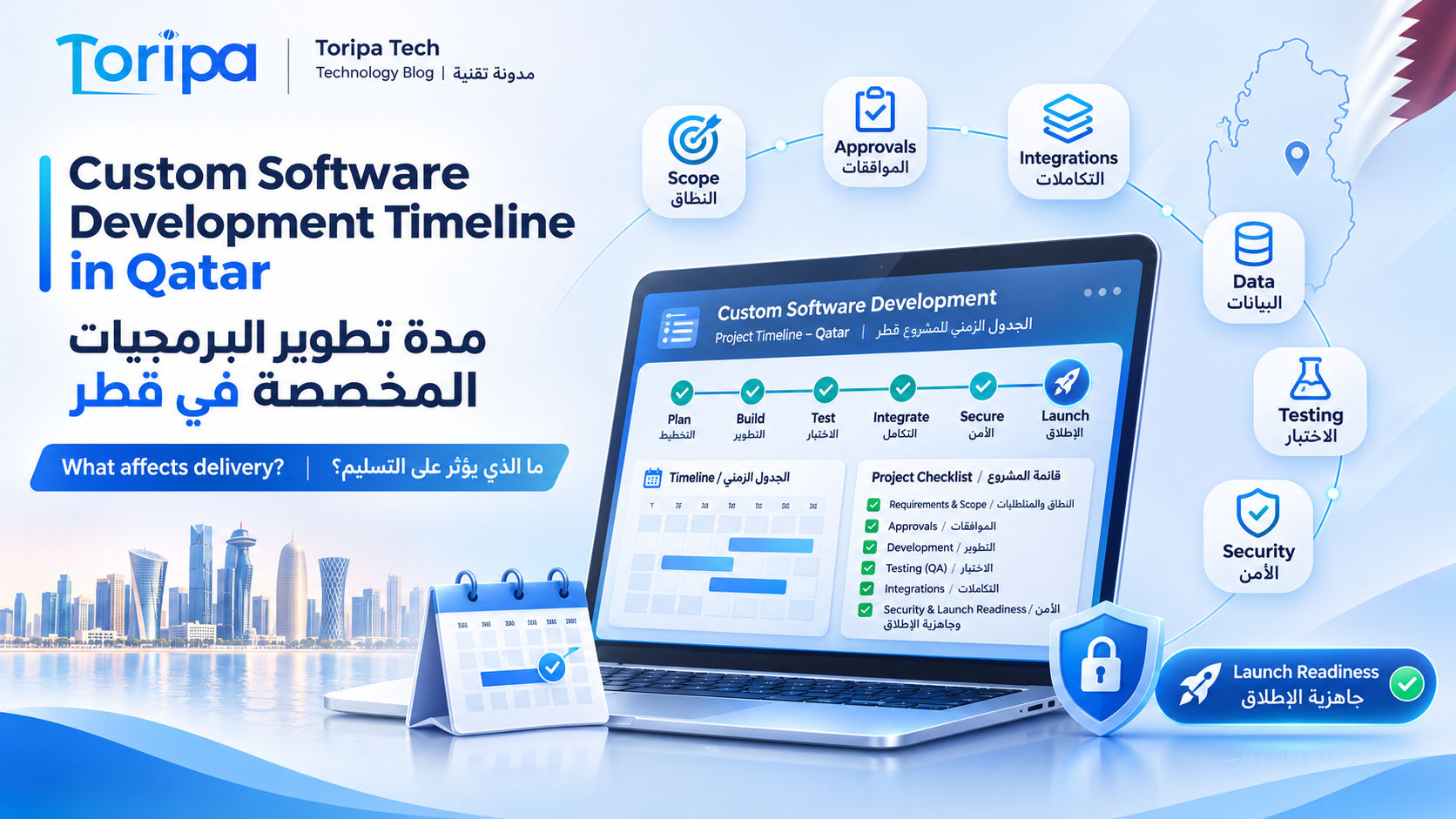
Business software delivery · Qatar
Custom Software Development Timeline in Qatar: What Affects Delivery?
How long does it take to develop custom software in Qatar? The useful answer is not a fixed number of weeks. It is a schedule that explains what will be delivered, what your business needs to approve and what could move the launch date.
Whether you're replacing spreadsheets in a Doha office or commissioning a system for teams across Qatar, this guide shows how to evaluate a realistic estimate, spot delivery risks and keep the first release moving.
How long does custom software take to build?
A delivery date depends on the amount of business logic, the number of user roles, the quality of existing data, the systems that must connect and how quickly people can make decisions. A focused approvals tool is not comparable to a company-wide platform with complex inventory, accounting and reporting.
Toripa Tech lists Typical timeline: 3–6 weeks for its Custom Software Development service. Treat that as a starting point for a conversation, not an unconditional commitment: the delivery schedule for your project should be agreed after the team understands the work, dependencies and sign-off process.
Three different dates to clarify
First demonstration: when you can click through an early workflow. Business acceptance: when agreed real-world tasks pass review. Production launch: when authorised users can safely use the system with the right data, access and support. An early demo does not mean the software is ready for daily operations.
Example: a 12-week custom software delivery plan
Imagine a Qatar service business commissioning a multi-department request-and-approval system with controlled data import, staff training and connections to existing tools. The following is a hypothetical illustration of how work might be organised—not a Qatar industry average, fixed quotation or guaranteed Toripa Tech project duration.
Weeks 1–2
Confirm the problem and first-release scope
A prioritised workflow, owners, exclusions, data sources and acceptance criteria.
Week 3
Review the experience and technical approach
Approved screen flows, access roles, integration checks and key decisions.
Weeks 4–7
Build the core workflow in short reviews
Usable demonstrations, feedback records and a working first-release feature set.
Weeks 8–9
Complete connections and system-level testing
Validated data, integration behaviour, permission checks and recorded defects.
Weeks 10–11
Run business acceptance and resolve findings
Realistic user tests, an agreed issue list and a release approval decision.
Week 12
Prepare launch and handover
Deployment checks, training, access, backups and a post-launch support plan.
Some work overlaps: developers can test features during implementation, while integration research can begin during discovery. The sample reserves explicit time for business testing and launch instead of quietly treating the last coding day as the go-live date. Complex projects may require several releases, longer approval cycles or additional testing.
Six factors that change a software project schedule
When comparing software development proposals in Qatar, look beyond the number of weeks. Ask which assumptions make that number possible and what happens if an assumption changes.
Changing scope
New workflows, reporting rules or approval paths require extra design, implementation and testing.
Keep it moving: Agree what must work at launch and assess new requests separately.
Slow business decisions
A developer may be ready to proceed while finance, operations or leadership have not approved a rule.
Keep it moving: Name one accountable decision-maker and a backup for each area.
Third-party access
An accounting, ERP or payment integration may depend on vendor documentation, credentials or sandbox approval.
Keep it moving: Verify access and supported operations before relying on the integration in a milestone.
Unprepared data
Duplicated customers, inconsistent columns and missing records create migration and reconciliation work.
Keep it moving: Choose a data owner and test a small representative import early.
Late security or language checks
Role permissions, Arabic right-to-left screens or document templates may reveal defects late in acceptance.
Keep it moving: Include them in early demonstrations and test cases.
Compressed acceptance testing
If real users only review the system on launch day, routine exceptions can become urgent rework.
Keep it moving: Reserve user testing and correction time in the plan.
A common timing trap is to count only developer hours. Waiting for a decision, a third-party account or an acceptance meeting is calendar time too. A reliable schedule records these external dependencies rather than hiding them in a single delivery promise.
Who is responsible for keeping delivery on track?
Custom software is a collaboration, not a package that appears once a contract is signed. The fastest decisions are the ones with a named owner, a deadline and enough information to make a choice.
Your business
Assign a project owner; supply realistic process examples and sample data; approve scope and designs; attend reviews; test real tasks; decide whether to accept the release.
Your development partner
Explain assumptions; estimate scoped work; show progress; identify risks early; document changes; test the system; prepare deployment, handover and support arrangements.
Outside providers
Confirm availability of existing-system APIs, third-party accounts, hosting or other services needed before a dependent feature can be completed.
For teams operating between Doha offices, branches and external vendors, schedule reviews around actual approver availability. If a finance manager can only review invoices at month-end, that constraint belongs in the plan before a milestone depends on their approval.
Why scope changes affect more than the coding estimate
Suppose the approved first release tracks service requests and manager approvals. Midway through development, someone asks for customer invoicing, automated messages and an additional branch-specific approval route. Those are not necessarily small additions: they introduce data fields, permissions, error cases, reporting and tests.
A useful change request describes the new outcome, its priority, its effect on cost and schedule and which existing work—if any—it replaces. If the original release solves an important problem without the extra features, a later phase may be the safer choice. When an urgent change is essential, agree on a revised milestone openly.
For the larger build decision, our custom software development guide for Qatar businesses explains how to approach a project before committing to a platform or partner.
Plan for security, bilingual use and launch from day one
Treat access permissions, audit history, error handling and backup responsibilities as deliverables that need definition and testing. The NIST Secure Software Development Framework recommends integrating secure practices throughout development, rather than depending entirely on a last-minute check.
For a Qatar system containing personal data, agree early on who can access records, where data will be processed and which responsibilities apply. Qatar's National Cyber Security Agency provides information on personal data privacy protection. Your actual requirements depend on the data and organisation; specific compliance obligations should be assessed appropriately rather than assumed from a generic timeline.
If staff or customers need both Arabic and English, agree which screens, messages, exports and PDFs will be bilingual. Right-to-left layout and mixed-language data should be tested with real examples before acceptance. For launch, also plan imports, user accounts, training, rollback options and who receives support requests in the first days of use.
Seven questions to ask before accepting a delivery date
Use these questions when reviewing a quotation. Clear answers are more valuable than an aggressive deadline with no visible assumptions.
- 1What exact workflow will be usable in the first release, and what is deliberately excluded?
- 2Which milestones require an approval, and who will make that decision?
- 3Which existing systems and datasets are still unverified dependencies?
- 4How frequently will we review working software rather than status slides?
- 5How much time is reserved for security, language testing, real users and fixing defects?
- 6What changes the delivery date, and how will the revised plan be agreed?
- 7What must be handed over before staff can safely operate the system?
To understand the wider delivery lifecycle, see the software development in Qatar guide.
Plan a useful first release with Toripa Tech
Tell us what your business needs to do, when it needs to work and which decisions or systems may slow delivery.
Some businesses need more than a public website. They need a system that matches how their work actually happens. Toripa Tech develops custom software solutions that organize data, simplify operations, reduce manual work, and give teams better tools to manage their business.
Bring a real workflow, the people who can approve it, an idea of the existing data and any immovable business dates. We can discuss scope, dependencies, milestone reviews and a delivery plan that makes room for proper testing rather than promising a launch date before knowing the work.
Custom Software Development: Starting from QAR 12,000. Typical timeline: 3–6 weeks. These are the currently published service starting point and timeframe, not a fixed quote or deadline for an unspecified project.
Custom software timelines in Qatar: frequently asked questions
How long does custom software development take in Qatar?
There is no reliable single duration for every business system. A focused first release with clear rules and limited integrations is easier to schedule than a multi-department platform. Toripa Tech's Custom Software Development service currently states: Typical timeline: 3–6 weeks; an individual project's delivery plan depends on its agreed scope, dependencies and acceptance requirements.
Can a custom business system be developed in three months?
A limited first release may fit a twelve-week illustration when requirements, approvals, data and integrations are sufficiently ready. Twelve weeks is not a standard delivery promise. A larger scope or uncertain third-party dependency can change the schedule substantially.
Does development start as soon as I pay a deposit?
The start of coding is not necessarily the start of the project. Discovery, requirements approval, access to existing systems and agreement on acceptance tests can be important prerequisites. Ask which activities and decisions are included in the quoted schedule.
What typically delays custom software delivery the most?
Common causes include unapproved requirements, changing scope, slow feedback, unavailable third-party access, poor source data and insufficient user testing. A transparent plan should name each dependency and who is responsible for resolving it.
Can development and testing happen at the same time?
Yes. Teams can review, test and refine each completed feature as work progresses. Final end-to-end and user acceptance testing still need dedicated attention before launch; overlapping stages does not remove that responsibility.
Will Arabic and English support affect the schedule?
It can. Right-to-left layouts, translated content, validation messages, notifications and documents require design and testing. If bilingual support matters to your Qatar users, include the specific surfaces and acceptance tests in the original scope.
How can our business help keep the delivery date realistic?
Provide one empowered decision-maker, representative sample data, early access to external systems, scheduled review sessions and staff for acceptance testing. Approve changes with their time impact documented instead of assuming they fit inside the original estimate.
Ready to Grow Your Business Online?
Let's discuss how we can help you build a powerful online presence that attracts customers and drives results.
Get in Touch