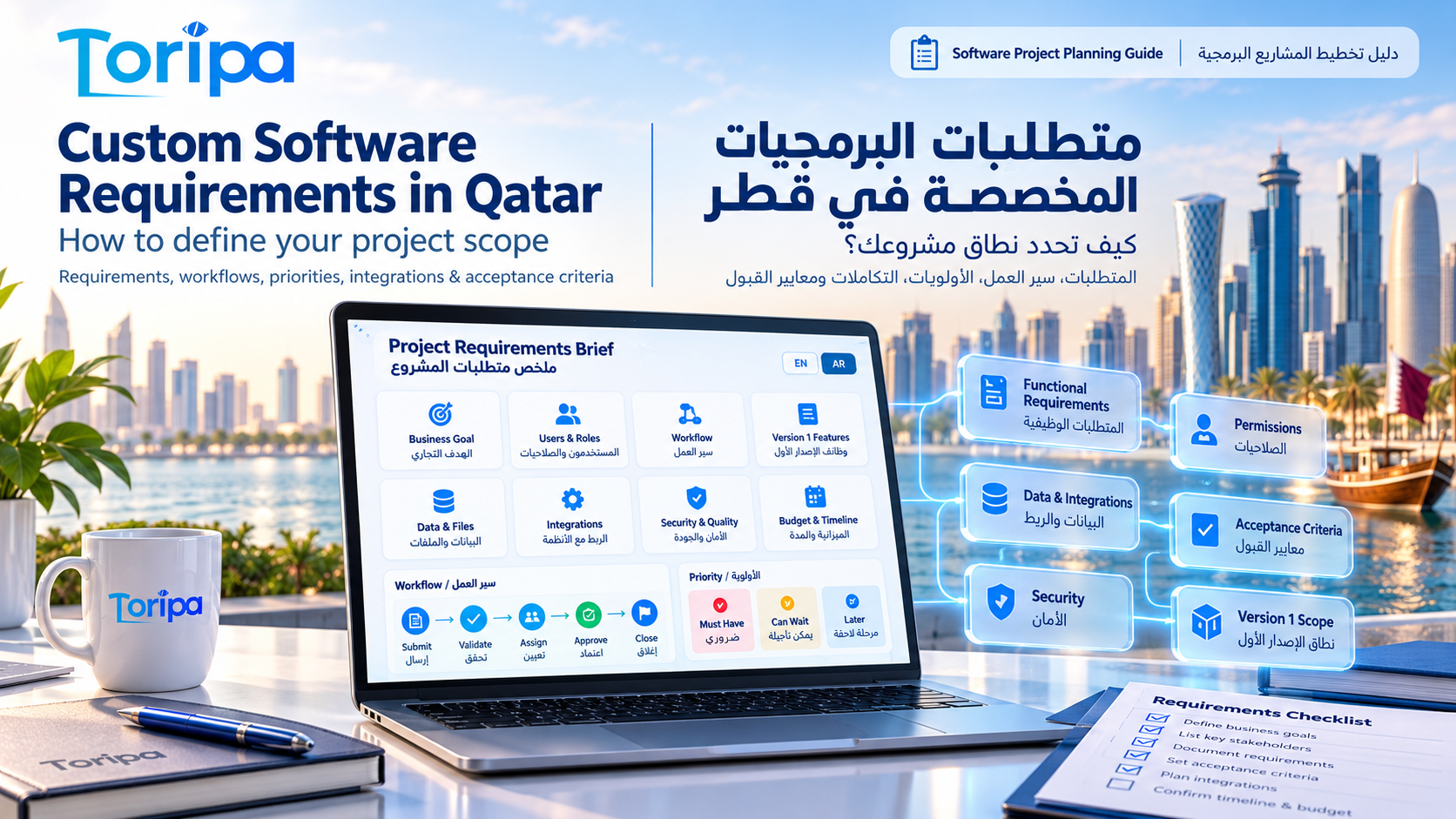
Software project planning · Qatar
Custom Software Requirements in Qatar: How to Scope Your Project
The most expensive software problems often start before anyone writes code: an unclear workflow, a missing decision-maker or a feature that means five different things to five people.
You don't need to become a software engineer to write a useful brief. This guide shows Qatar business owners exactly what to prepare, how to prioritise the first release and how to recognise a scope that can actually be quoted and tested.
Start with the problem—not a 40-page feature wish list
A workable software specification explains who needs to do what, which rules govern the work, what information is involved and how success will be checked. A request like “we need an ERP” is too broad. “We need branch managers to approve purchase requests in one place, with limits and a clear audit history” is something a team can investigate.
The established ISO/IEC/IEEE 29148 requirements engineering standard describes the discipline of defining and managing requirements. Your small business does not need to purchase or implement a formal standard to benefit from the principle: requirements should be clear enough for two people to understand and verify the same outcome.
A useful first sentence for your brief
“Our operations team currently tracks service requests in shared spreadsheets and messages. We want one controlled process that records requests, assigns owners, shows approvals and lets customers see the status of their own request.”
Illustrative example, not a description of a named client.
Your eight-part software requirements brief
Copy these headings into a document and write a few honest sentences under each one. Uncertain answers are fine: identify them as decisions to make during discovery rather than quietly guessing.
1Business outcome
What should improve? Example: managers can approve service requests without chasing messages.
2People and permissions
List who submits, reviews, approves, edits, exports and administers each record.
3Current workflow
Show how work moves today, including delays, exceptions and spreadsheets used along the way.
4First-release scope
Name the must-have actions needed for a useful launch, and what can wait.
5Data and documents
List customer records, uploaded files, mandatory fields, existing data sources and export needs.
6Other systems
Identify platforms to connect and who controls their API accounts or documentation.
7Quality and security
Define access restrictions, backup needs, performance expectations and applicable privacy duties.
8Project constraints
Set an indicative budget, target launch, decision-maker and people available to review working software.
For a custom software development quote in Qatar, this brief is more valuable than sending a list of technologies you have heard of. A competent developer can recommend an architecture after understanding the actual needs.
Draw one real workflow, including where it goes wrong
Take a frequent task from your Doha office, store, clinic or service operation. Follow a real request from beginning to end. Include who starts it, who owns the next step, what triggers an approval and what happens when information is incomplete. A simple sequence is enough:
01
Request received
Customer submits the required details.
02
Validate
Staff checks fields and asks for missing information.
03
Assign
An authorised user chooses an owner.
04
Approve
Manager reviews cases that exceed a defined threshold.
05
Close
Record outcome, notify the right people and preserve history.
Now describe the exceptions: duplicate requests, a manager who is absent, an uploaded file that cannot be read, a cancelled case and an integration that is offline. Software built only for a perfect demo rarely survives ordinary working days.
Separate four kinds of requirements
Functional requirements: what the system does
A customer submits a request; an operations user assigns it; a manager approves exceptions; the customer sees the current status.
Check: Can you demonstrate the full task, including rejected or incomplete submissions?
Permission rules: who is allowed to do it
Staff can edit only assigned cases; a manager can reassign cases; an external customer cannot see another customer's files.
Check: What should happen when the wrong person tries to open or change a record?
Data and integrations: what must be reliable
Each request has a unique reference; records import from an agreed spreadsheet; invoice numbers sync only if the accounting API supports it.
Check: Where is the source of truth, and what happens if an integration fails?
Non-functional requirements: how well it works
Agree on device support, language experience, audit logs, access security, availability expectations and backup/recovery responsibilities.
Check: How will you test these expectations before accepting the release?
Keep a named owner for each requirement. An operations lead may approve a workflow while a finance lead confirms invoice rules and an administrator checks access. Ask actual users to validate the steps; the person paying for software does not always perform the tasks it will change.
Decide what belongs in version one
The fastest way to lose control of a scope is to call every idea “essential”. Make the first release responsible for one valuable, end-to-end outcome. Put each request into a priority category and record what is explicitly excluded.
Must have
Without it, the first release cannot complete the core workflow safely.
Example: Submit request, assign owner, approve or reject, track status, and control access.
Should have
Meaningful time savings, but a temporary manual solution is acceptable at launch.
Example: Bulk updates, filtered exports and optional reminders.
Later
Useful expansion after real users validate the first version.
Example: Predictive reports, advanced dashboards and extra department workflows.
If a new request appears during development, ask whether it replaces an existing requirement, belongs in a later phase or needs a separately priced change. That is a business decision, not a confrontation with the developer.
Write acceptance criteria that can be tested
A useful custom software requirement includes a way to know when it is done. Instead of “modern dashboard” or “easy to use”, define a realistic action, a rule and an expected outcome.
Too vague
The system should have good approvals.
Ready to test
Given a request over the agreed approval limit, when a staff member submits it, then its status becomes 'Pending manager approval' and only an authorised manager may approve or reject it.
Too vague
The dashboard should be fast.
Ready to test
With the agreed representative test dataset and supported connection, the primary requests list should load within the target time documented in the approved test plan.
Too vague
It must support Arabic.
Ready to test
For the agreed staff and customer screens, Arabic mode displays labels and inputs correctly in right-to-left layout, while exported documents use the approved Arabic templates.
Choose who will test each requirement, which sample data they will use and who can sign off. A clear acceptance process protects your budget and reduces disputes over whether an expected function was actually delivered.
Don't postpone integrations, data and privacy
List every existing system the new product must read from or update. Note the system owner, supported API, available test account, rate limits, authentication method and what staff should do during an outage. Before promising automatic synchronisation, confirm the other vendor actually allows it.
If you are migrating Excel sheets, ask who will clean duplicates, standardise columns and verify totals. Specify record ownership and retention instead of assuming imported data will somehow become accurate automatically.
For Qatar businesses handling personal data, privacy belongs in the initial requirements. Consider what personal information is necessary, which staff may access it, how it is protected and whether external processors are involved. Qatar's National Cyber Security Agency provides guidance for entities under the Personal Data Privacy Protection Law. The correct obligations depend on the organisation and processing activity; seek professional advice for compliance decisions.
Also say exactly where bilingual support is needed: staff screens, customer portals, forms, notifications and generated PDFs. An Arabic right-to-left interface is more than translating buttons.
Six avoidable mistakes that turn a good project into rework
- Describing only screens and colours without explaining the decisions users need to make.
- Letting one manager describe a workflow that several teams perform differently.
- Treating an integration as guaranteed before checking the vendor's API access and limits.
- Bundling every future feature into the launch instead of prioritising a viable first release.
- Forgetting existing data quality, user training, permissions, backups and handover.
- Approving a proposal with vague words such as 'complete', 'easy' or 'fully automated' but no acceptance test.
Before signing, ask the development partner to identify assumptions, exclusions, external dependencies, review checkpoints and the change-request process. A shorter proposal with clear boundaries is worth more than an impressive list of undefined promises.
If you're still deciding what kind of system to commission, start with our custom software development guide for Qatar businesses.
For the larger picture, see our software development guide in Qatar.
Bring Toripa Tech your problem. We'll help shape the right first release.
You shouldn't have to purchase an oversized platform just to fix one painful workflow—or pay for a build nobody can define.
Some businesses need more than a public website. They need a system that matches how their work actually happens. Toripa Tech develops custom software solutions that organize data, simplify operations, reduce manual work, and give teams better tools to manage their business.
Share the brief above, even if a few answers are uncertain. We'll focus the discussion on what matters: real users, concrete decisions, working data, what is in scope and what success looks like. A well-scoped first release creates a stronger foundation for future improvements.
Custom Software Development: Starting from QAR 12,000. Typical timeline: 3–6 weeks. These are the published service starting point and typical timeframe, not a binding quote or schedule for an unspecified project.
Software requirements: frequently asked questions
What requirements should I prepare before hiring a custom software company in Qatar?
Start with your business goal, a real current workflow, users and permissions, key data, integrations, must-have features, privacy/security considerations, budget constraints and who can approve decisions. A developer can help refine these into a detailed specification; you do not need to design the database yourself.
Do I need a full software requirements specification before asking for a quote?
No. A clear one- or two-page business brief is a useful starting point for discovery. A reliable fixed-scope quote normally needs more detail about business rules, data, external systems, acceptance criteria and exclusions before the final scope can be agreed.
What is the difference between a requirement and a feature?
A feature is a capability such as an approval dashboard. A requirement defines the exact behaviour, users, limits or quality conditions that make it useful, such as who can approve, what data appears, and what happens when approval is rejected.
How do I stop requirements from expanding during development?
Agree on a prioritised first-release scope, record exclusions, name a decision-maker and define testable acceptance criteria. New ideas can be assessed for their effect on price and delivery before being approved as changes instead of being silently added.
Should Arabic and English support be specified at the start?
Yes, when your Qatar business needs both. Specify which screens, roles, forms, notifications and exported documents require each language, and test right-to-left interfaces rather than assuming a translated menu is enough.
Who should approve the software requirements?
A business owner or accountable project sponsor should approve the scope, with input from staff who perform the work, administrators who manage the system and anyone responsible for data or security. Final acceptance should use agreed real-world test cases.
Can Toripa Tech help define requirements before development?
Yes. Share your current process, business problem and priorities when enquiring about Custom Software Development. We can discuss a focused first-release scope and the information needed for a realistic proposal. The exact scope, price and delivery plan depend on the agreed requirements.
Ready to Grow Your Business Online?
Let's discuss how we can help you build a powerful online presence that attracts customers and drives results.
Get in Touch