Business technology decisions · Qatar
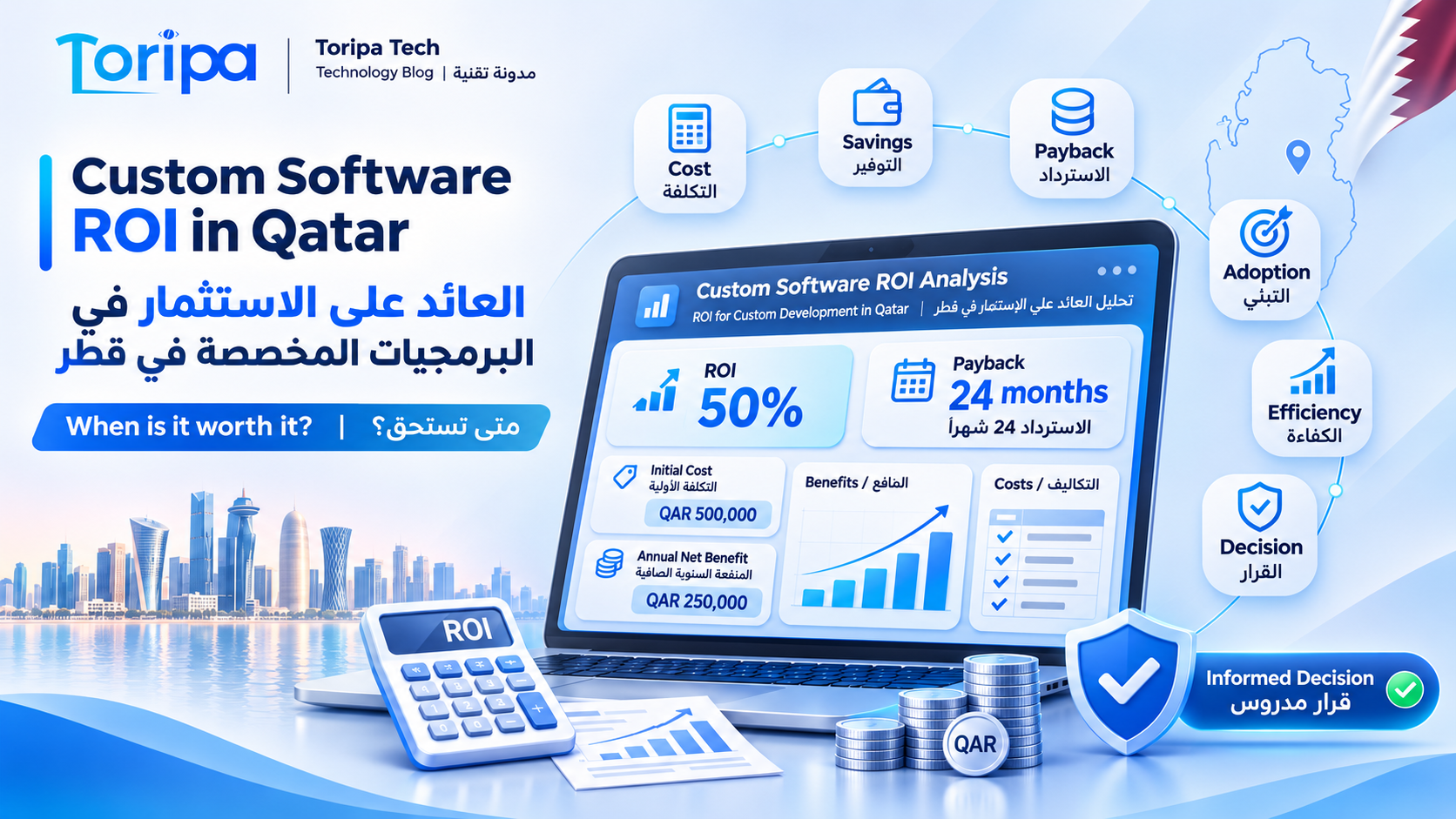
Custom Software ROI in Qatar: When Is Building Worth It?
A custom system can remove costly manual work—but an impressive feature list does not prove a return on investment. The useful question is whether measurable benefits outweigh the full cost of building and running it.
This guide gives Qatar businesses a practical way to compare options, calculate payback using transparent QAR assumptions and decide when a smaller or ready-made solution is the smarter purchase.
When does custom software create business value?
Think of a company with service teams in Doha and another location in Qatar. Staff export requests from one system, copy them into spreadsheets and chase approvals through messages. A custom workflow might connect the steps and reduce repeated work. But that benefit must be measured against the current process—not assumed because the new interface looks cleaner.
A worthwhile system usually solves a frequent, important problem that a reasonably priced existing tool cannot handle well. If the process is common and a ready-made product covers it, buying and configuring that product may deliver a faster, lower-risk return.
If you're still defining the broader project, begin with our custom software development guide for Qatar businesses before treating a development quotation as an investment decision.
Four sources of return—and one important distinction
Look at what changes in your operations, not just what the software can do. Cash saved and working time freed are both useful, but they are not interchangeable in a financial forecast.
Staff capacity recovered
Measure hours spent re-keying data, chasing approvals or producing the same report twice. Multiply only the time genuinely freed by its defensible business value—not automatically by payroll savings.
Costs you can actually retire
Count subscriptions, duplicate tools, outsourced processing or recurring charges only if the new system will replace them and the cancellation is practical.
Errors and delays reduced
Use a baseline of documented corrections, outside fees, lost orders or avoidable rework. Do not count the same staff hours again in a second savings category.
Better decisions and experience
Faster visibility, traceability and customer service can matter greatly, but treat them as non-financial outcomes until there is credible evidence for a monetary value.
Example: saving ten employee hours per week does not automatically reduce wages. Your organisation may instead gain capacity for customer service or backlog reduction. If you assign a monetary value to that capacity, document the hourly rate, the tasks that will replace the old work and how much of the saved time can genuinely be used.
Calculate the total cost before calculating ROI
A software quote is only one part of the cost. Choose a consistent period—often three years for an initial business comparison—and include the costs and savings that change because of your decision. If you compare custom software with packaged software, use the same horizon for both.
Initial discovery, design, development, testing, deployment and handover
Data preparation, integration access and migration checks
Cloud hosting, backups, security monitoring and third-party API usage
Maintenance, support, fixes, updates and future changes
Employee training, adoption time and process adjustments
Exit, replacement or data-export work when the system changes
For a more formal decision, account for when cash flows occur and the cost of capital instead of relying on a simple total. The UK government's Green Book appraisal guidance illustrates why the lifetime of an investment, uncertainty and the timing of costs and benefits matter. It is a general appraisal reference, not a Qatar-specific business rule.
Worked example: software ROI for a Qatar operations team
Imagine a company replacing repeated data entry and disconnected approvals with one internal system. All amounts below are hypothetical QAR planning inputs, not Qatar market averages, Toripa Tech prices or a savings forecast for your organisation.
One-time build, setup, migration and training
QAR 120,000
Initial investment
Manual work currently performed
12 hours/week × 50 weeks × QAR 120/hour
Baseline assumption
Time value at 75% realisation
QAR 54,000/year
72,000 × 75%
Retired overlapping software subscriptions
QAR 14,000/year
Avoided cash spend
Avoided outsourced data-processing invoices
QAR 12,000/year
Separate avoidable expense
Gross annual benefit
QAR 80,000/year
54,000 + 14,000 + 12,000
Hosting, support and ongoing improvements
QAR 20,000/year
Recurring operating cost
Net annual benefit
QAR 60,000/year
80,000 − 20,000
The full value of the 600 recovered hours would be QAR 72,000. The example counts only 75% of that value (QAR 54,000) to reflect the reality that not every saved minute becomes usable business output. The QAR 14,000 in cancelled tools and QAR 12,000 in external invoices are assumed to be separate, verifiable cash expenses—not a second count of the same hours.
Simple payback after benefits begin
24 months
QAR 120,000 ÷ QAR 60,000 per year × 12
Three-year net gain
QAR 60,000
3 × QAR 60,000 − QAR 120,000
Simple three-year ROI
50%
QAR 60,000 net gain ÷ QAR 120,000 initial cost
How to read these figures: the first year's net benefit after the initial outlay is negative. The example reaches simple cumulative break-even at the end of year two, assuming benefits start immediately and remain steady. Discovery time, gradual adoption, tax treatment, financing, inflation and discounted cash flows are not modelled; including them could change the result.
What if employees use less of the time saved?
ROI is sensitive to adoption. Keep the initial QAR 120,000 investment, the QAR 26,000 in avoidable annual cash charges and QAR 20,000 in annual running costs unchanged. Only vary the share of the QAR 72,000 potential time benefit that becomes useful.
Cautious
Time value realised50%
Annual net benefitQAR 42,000
Simple paybackAbout 34 months
Three-year ROI5%
Base case
Time value realised75%
Annual net benefitQAR 60,000
Simple payback24 months
Three-year ROI50%
Strong adoption
Time value realised100%
Annual net benefitQAR 78,000
Simple paybackAbout 18.5 months
Three-year ROI95%
Even the cautious example has a positive simple three-year return of just 5% before risk, financing and timing adjustments. That narrow margin may not justify a bespoke build. Test the downside case before approving the full scope, not after paying for development.
Build, buy or improve what you already use?
Configure an existing tool
Often best when the workflow is standard, vendor support is adequate and the ongoing licence is predictable. Include setup, integrations, training and subscription growth in the comparison.
Build a focused custom system
Worth evaluating when your approvals, data or roles are distinctive, recurring friction is measurable and an existing tool requires expensive compromises.
Improve the current process
Sometimes clearer ownership, better data and fewer unnecessary approvals solve enough of the problem without a large software investment.
For businesses serving Arabic- and English-speaking teams in Qatar, include the actual costs of bilingual screens, right-to-left testing, integrations and support in each option. Do not assume these features are included in an existing licence or a custom quotation. Qatar's MCIT Digital Economy Hub describes national efforts to support digital innovation; that policy context does not replace an individual company's financial case.
How to validate the return after launch
An ROI estimate is a decision tool, not a result. Agree who owns measurement before work starts, and review the real workflow after the new system is in use.
Step 1
Record the current workflow
For two to four representative weeks, time the task, collect recurring invoices and log errors. Include branch differences and peak periods.
Step 2
Choose the measurable first release
Define the single workflow, user groups, integrations and approval checkpoints needed to generate the proposed benefit.
Step 3
Assign owners to the assumptions
Finance validates the numbers, operations validates the baseline and users validate whether the new workflow truly saves time.
Step 4
Review actuals after launch
Compare the baseline with results at around 30 and 90 days, then update the benefit estimate for adoption, missed costs and unexpected work.
Track a small scorecard: minutes per completed request, error or correction rate, paid tools retired, verified external charges avoided, actual user adoption and the number of requests completed. Separate one-time launch effects from sustainable improvements.
For a wider view of planning and delivery, read the software development in Qatar guide.
Seven questions to ask before approving the investment
- 1What are we comparing against: current tools, a packaged product or doing nothing?
- 2How were staff hours measured, and will the saved capacity actually be used?
- 3Which subscriptions or vendor charges can we cancel, and when?
- 4Are discovery, integrations, security, migration, support and training included?
- 5What happens to the business case if adoption or savings are only half of the target?
- 6Which workflow and results will be delivered in the first release?
- 7Who measures the benefit after launch, and who can change the process if results lag?
Scope a useful first release with Toripa Tech
Bring the workflow, the current costs and the results you want to measure—not just a list of features.
Some businesses need more than a public website. They need a system that matches how their work actually happens. Toripa Tech develops custom software solutions that organize data, simplify operations, reduce manual work, and give teams better tools to manage their business.
A discussion can start with examples of the work staff do today, the data and integrations involved, and the person who will approve a first release. We can review what belongs in scope and what should be compared with a simpler alternative; the business case remains yours to validate with real operating figures.
Custom Software Development: Starting from QAR 12,000. Typical timeline: 3–6 weeks. These are the current service catalogue starting point and timeframe, not the example's project price or a guaranteed payback period.
Custom software ROI in Qatar: frequently asked questions
Is custom software worth the investment for a business in Qatar?
It can be when a recurring business problem is costly enough, existing products cannot solve it economically and measured benefits exceed the full cost over a realistic period. It is not inherently better than an off-the-shelf product. Compare both options using the same assumptions and include ongoing operating costs.
How do I calculate ROI for a custom software project?
Estimate financial and defensible operational benefits over a defined period, subtract upfront and recurring costs, then divide the net gain by the upfront investment for a simple illustrative ROI. State the time horizon and assumptions. For a formal investment decision, finance may also use discounted cash flows and other risk-adjusted measures.
How long does custom software take to pay for itself?
There is no universal payback period. Divide the initial cost by expected net annual benefit when the benefit is positive and reasonably steady, then convert to months. In this article's hypothetical base case, QAR 120,000 divided by QAR 60,000 per year gives 24 months after benefits begin; ramp-up can extend that period.
Does employee time saved count as cash savings?
Not automatically. If employees use the released hours for higher-value work, it is a capacity or productivity benefit, not a direct reduction in payroll. Treat actual cash savings and the estimated value of redeployed time separately, and explain how much of that capacity can realistically be used.
What costs should be included in software ROI?
Include the initial build or licence, setup, integration, migration, testing, training, hosting, security, support, subscriptions, changes and eventual replacement or exit work where relevant. Compare those against the ongoing costs of your present solution and any ready-made alternative.
Can a small Qatar company get ROI from custom software?
Yes, if a small but repetitive problem creates measurable avoidable cost and the first version stays tightly scoped. However, a low-cost ready-made tool can be the stronger investment when the workflow is standard or usage is limited.
Does Toripa Tech guarantee a particular ROI?
No. A return depends on each business's baseline, process adoption, data, costs and results. Toripa Tech lists Custom Software Development from Starting from QAR 12,000, but an accurate project business case requires a defined scope and an agreed quotation; the figures on this page are examples, not service prices or promised savings.
Ready to Grow Your Business Online?
Let's discuss how we can help you build a powerful online presence that attracts customers and drives results.
Get in Touch