Custom vs Off-the-Shelf Software in Qatar: Which Fits Your Business?
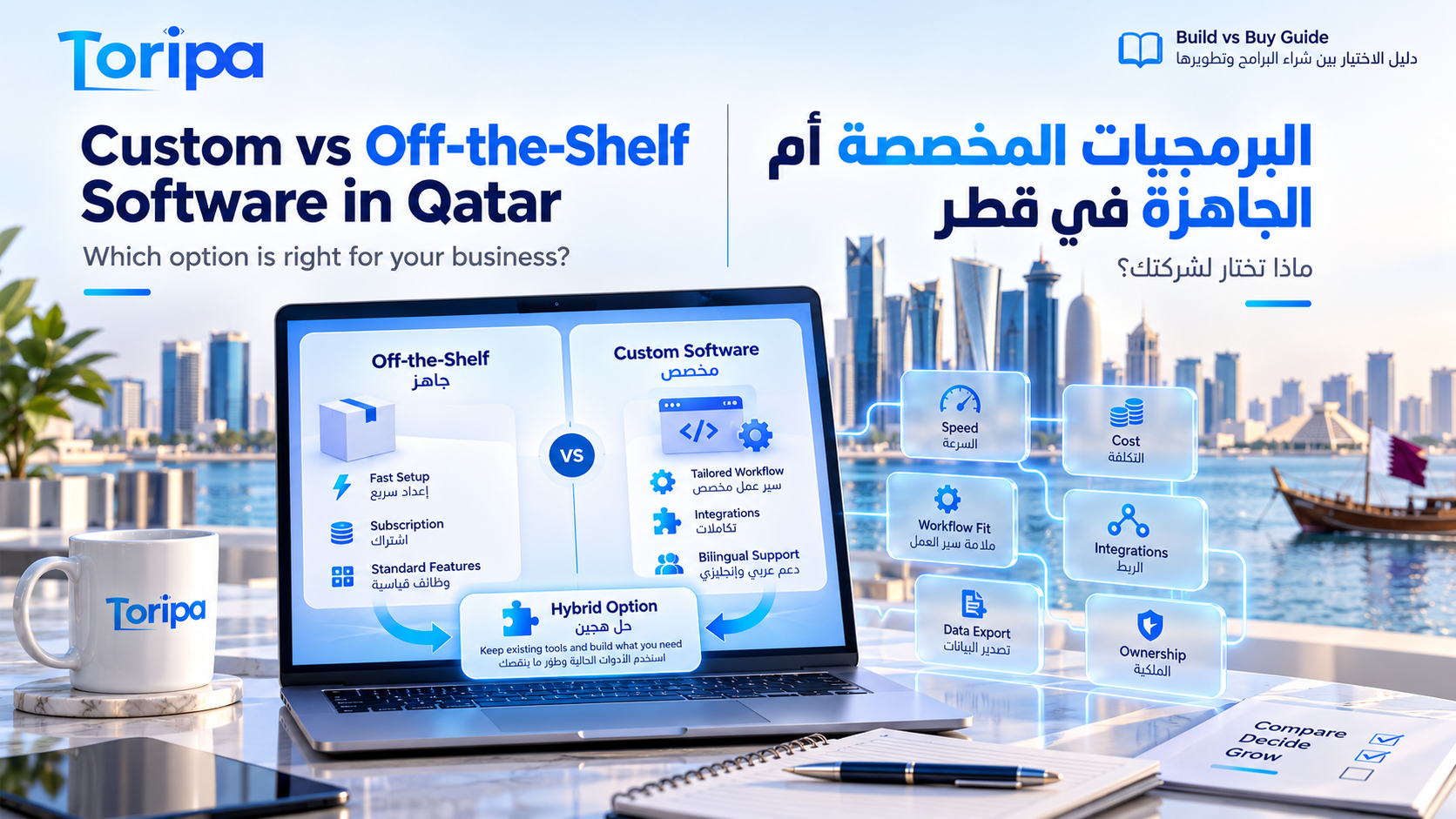
Build vs buy · Qatar business guide
Custom vs Off-the-Shelf Software in Qatar: Should You Build or Buy?
A familiar subscription is not always the simplest choice—and a custom application is not always the smartest investment. The right answer depends on how your business actually operates, what must connect, and how much control you need as the company grows.
This comparison helps Qatar companies decide when to buy an existing tool, commission custom software, or combine the two without paying for unnecessary complexity.
The short answer: buy the standard parts, build what makes you different
If a proven application already handles your core requirements, buying it can save time and reduce the work your team must maintain. If your team has to work around the application every day, the apparent convenience quickly disappears. A focused custom system can remove those workarounds and make the software fit the business—not the reverse.
Choose ready-made when the work is standard
Your needs are close to common accounting, scheduling, email, CRM or ticketing workflows, and a real product trial proves the fit.
Choose custom when exceptions define the work
Important approvals, customer rules, pricing logic, branch operations or permissions cannot be handled reliably without costly workarounds.
Choose hybrid when most of the business is standard
Keep a proven system of record and build a focused portal, dashboard or connector around the missing workflow instead of rebuilding everything.
Custom software vs ready-made software: seven differences that matter
These are practical trade-offs, not universal promises. A sophisticated commercial platform may offer extensive functionality; a small custom application may remain deliberately narrow. Compare the actual proposed products and deliverables.
| Decision factor | Off-the-shelf software | Custom software |
|---|---|---|
| Getting started | Typically quicker when your process fits existing features and setup is simple. | Requires discovery, design, development and testing before launch. |
| Workflow fit | Your team adapts to the product's available steps, roles and limitations. | Workflows, approvals and interfaces can be designed around your actual operations. |
| Costs | Licences and setup can be accessible at first; seats, add-ons and renewals can accumulate. | Greater initial development effort; hosting, support and enhancements remain ongoing costs. |
| Integrations | Easier if compatible integrations already exist; hard if an essential system is unsupported. | Can target required integrations, subject to APIs, access rights and third-party limits. |
| Arabic / English | Depends on the exact product, edition, fields, layouts and support arrangements. | Language flows and right-to-left screens can be included in the agreed scope. |
| Changes | Roadmap and deep product changes generally depend on the vendor. | You can commission specific changes, within your contract, budget and technical constraints. |
| Control and exit | Confirm export formats, contract terms, vendor lock-in and account ownership. | Agree in writing on source code, data access, hosting accounts, handover and maintenance. |
The biggest mistake is comparing a feature-filled ready-made demo to a vague promise to “build anything.” Ask to see the real workflow, permissions, reporting and failure handling for both options. That is where the meaningful differences emerge.
Three situations Qatar businesses will recognise
A standard sales process
A small trading company needs contact management, basic quotations and ordinary follow-up reminders. Staff have tested a CRM that already does those tasks well, supports their language needs and exports their records.
Likely choice: start with the ready-made CRM.
Custom development would duplicate working features without solving an important unmet need.
Branch-specific approval rules
A Doha-based service business coordinates requests across locations, with different approval thresholds, Arabic and English customer updates, attachments and management visibility. Teams currently copy details between chats, spreadsheets and unrelated tools.
Likely choice: evaluate a tailored workflow system.
If trials cannot satisfy the critical rules without fragile add-ons, a focused custom application could be the cleaner option.
Good accounting, missing client portal
A company trusts its accounting package but needs clients to submit requests, follow progress and download approved documents without giving them access to internal financial records.
Likely choice: keep accounting; build the portal.
Integration feasibility must be checked first. Replacing the entire accounting platform may offer little benefit.
These are illustrative scenarios, not claims about Toripa Tech customers or named Qatar businesses.
Do not compare only the sticker price
An off-the-shelf product may start with a low monthly plan and become more expensive as staff numbers, automation needs, storage and integrations grow. A custom build needs a development budget first, followed by its own infrastructure, support and upgrade costs. Neither is automatically cheaper after three years.
Count the cost of buying
- Subscriptions, user seats and required modules
- Onboarding, training and migration
- Paid integrations, automations and usage charges
- Workarounds, duplicate entry and vendor switching
Count the cost of building
- Discovery, design, development and testing
- Data migration and third-party API costs
- Hosting, backups, monitoring and security
- Bug fixes, support and later improvements
Get both options priced for the same requirements and time period. Also ask what happens if your team doubles, the vendor raises prices or you need to export every record. An inexpensive licence is not inexpensive if the actual work still happens outside the system.
A seven-question build-or-buy checklist
Before requesting a custom development quote in Qatar, trial the best ready-made candidate with real work. A glossy feature list cannot answer these questions for you.
- 1Can a ready-made product complete the five most important tasks without spreadsheets or duplicate entry?
- 2Have the real users tested the product using actual scenarios—not just watched a demo?
- 3Do the necessary Arabic and English screens, documents and notifications work as expected?
- 4Can essential data move into and out of the platform in a usable format?
- 5Are existing integrations supported, including the difficult failure and retry cases?
- 6Do the three-year operating costs and exit conditions still make business sense?
- 7Are you paying for a few small adjustments—or redesigning the whole team around the tool?
If most answers are positive, configure the existing product before commissioning a replacement. If the essential workflows repeatedly fail in testing—or the workarounds consume the same effort you wanted to eliminate—write down those gaps. They become the strongest starting point for a custom software brief.
For the broader process, read our custom software development guide for Qatar businesses, covering project preparation, scope, delivery and ownership.
You can also explore the wider software development options in Qatar.
The hybrid route: often the most commercially sensible
You do not have to choose between buying everything and building everything. A focused custom layer can preserve familiar tools while eliminating the costly gap between them.
Keep reliable core systems
Do not rebuild payroll or accounting merely because one operational workflow is awkward.
Verify the connection points
Ask vendors about APIs, access permissions, usage limits and ownership of integration credentials.
Build one high-impact workflow
Commission the missing dashboard, approval flow, portal or reporting view—not an imagined all-in-one platform.
Test with real staff, then expand
Check data accuracy, exceptions and handoffs before adding another department or feature set.
Qatar-specific details to test before signing
For a team in Doha or elsewhere in Qatar, ask suppliers to demonstrate the exact bilingual experience you require—including Arabic right-to-left screens, English views, customer messages, export files and any document templates. Do not assume “Arabic supported” covers every part of the system.
If personal data is involved, assess where information is processed, who can access it, the security controls and your contractual responsibilities. Qatar's National Cyber Security Agency publishes guidance on the Personal Data Privacy Protection Law. Actual obligations depend on your processing and circumstances; obtain suitable specialist advice where necessary.
Qatar's digital transformation programme for SMEs highlights the business value of adopting appropriate digital tools. But a government initiative does not mean every business needs custom development: select technology because it fixes a real process.
Why involve Toripa Tech before you choose?
Don't buy a complicated package your team must fight—or commission an enormous system when a smaller one will do. Let's isolate the actual bottleneck and build around that.
Some businesses need more than a public website. They need a system that matches how their work actually happens. Toripa Tech develops custom software solutions that organize data, simplify operations, reduce manual work, and give teams better tools to manage their business.
Our recommendation is practical: keep working software where it makes sense, then invest in the functionality your business truly lacks. Your proposal should define the first release, integration assumptions, acceptance criteria and operational responsibilities. A clear scope is more useful than a dramatic promise.
Custom Software Development: Starting from QAR 12,000. Typical timeline: 3–6 weeks. Those are the published service starting point and typical timeframe—not a fixed price or guaranteed deadline for an unspecified scope.
Build vs buy: frequently asked questions
Is custom software better than off-the-shelf software for a business in Qatar?
Neither is automatically better. Ready-made software is usually sensible for common tasks that it already handles well. Custom software becomes attractive when important workflows, permissions, integrations or customer experiences do not fit available products. A hybrid solution can often give you the best of both approaches.
Which is cheaper: buying software or building it?
Subscription software may be cheaper to start, but seats, modules, integrations, implementation and future price changes can add up. Custom software usually has a higher initial build commitment plus operating and support costs. Compare like-for-like features and the total cost over the same period, not only the first invoice.
Can ready-made software be customised?
Often yes, through configuration, add-ons, automation and supported APIs. The important question is whether those changes are stable, supported, affordable and capable of meeting your critical business rules without fragile workarounds.
Does custom development mean my company owns the source code?
Not automatically. Source-code rights, third-party licences, credentials, infrastructure and data export should be addressed explicitly in the signed agreement. A project being custom-built does not, by itself, settle intellectual property ownership.
What if we need Arabic and English software in Qatar?
Test the exact user journeys in both languages. This includes right-to-left layout, forms, documents, search, notifications and staff permissions. A ready-made product may support some of those requirements; custom software can include them when they are agreed in scope.
Can Toripa Tech build only the missing part of our existing software setup?
You can discuss that approach with us. Toripa Tech's Custom Software Development service covers admin dashboards, client portals, internal business tools, custom workflows, secure, scalable web applications. Whether an integration or extension is feasible depends on the third-party platform's access, APIs and the agreed requirements.
How long will a custom system take to develop?
Toripa Tech currently lists Typical timeline: 3–6 weeks. It describes the service's typical timeframe, not a fixed promise for every system. Scope, approvals, integration access, data readiness and testing determine a realistic project plan.
Ready to Grow Your Business Online?
Let's discuss how we can help you build a powerful online presence that attracts customers and drives results.
Get in Touch