E-Commerce Website Cost in Qatar: Features, Payments & Budget
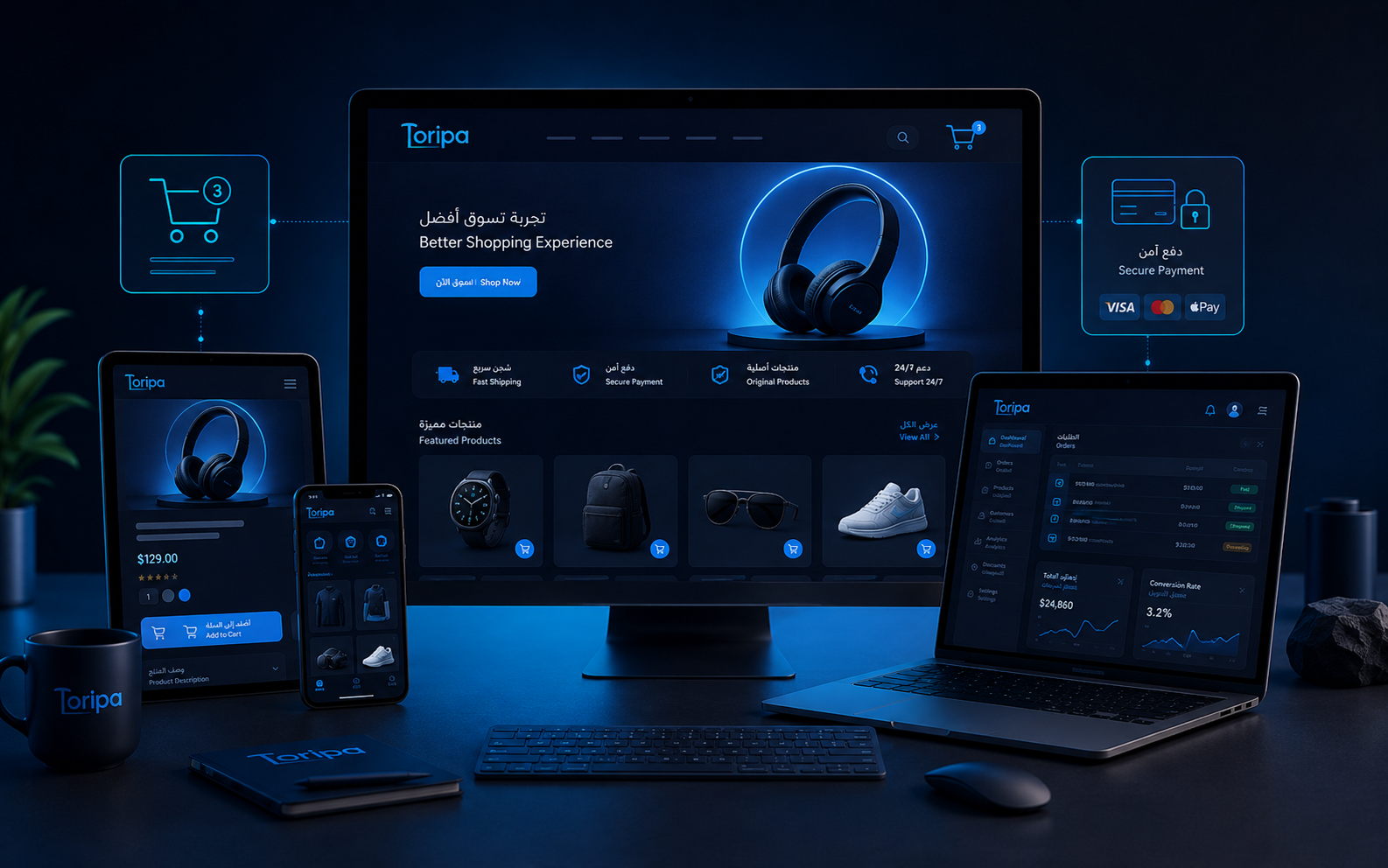
E-commerce website cost · Qatar · updated 27 August 2026
E-Commerce Website Cost in Qatar: Features, Payments & Budget
If you want the number first: Toripa Tech currently lists E-Commerce Development at Starting from QAR 1,500, with Typical timeline: 2–4 weeks. That is a starting point for a focused scope, not a flat price for every store; The starting price is for a focused e-commerce scope. Product volume, payments, shipping, customer accounts, inventory, integrations, bilingual requirements, and custom commerce logic can increase the final quote.
That starting point is extremely aggressive against public Qatar e-commerce pricing. So this guide does not hide behind “contact us for a quote.” We put the market numbers and sources on the page, explain why the gap exists, and show exactly which requirements make an online store legitimately more expensive.
The short answer: what should you budget?
Toripa Tech starting point
Starting from QAR 1,500
The starting price is for a focused e-commerce scope. Product volume, payments, shipping, customer accounts, inventory, integrations, bilingual requirements, and custom commerce logic can increase the final quote.
Reference timeline
Typical timeline: 2–4 weeks
Products, content, payment onboarding, shipping and integrations can move the real delivery date in either direction.
Normalize the scope
Check custom design, product count, payments, bilingual delivery, shipping, admin, ownership, support and integrations. “E-commerce website” is not one standardized product.
Public e-commerce prices in Qatar — and the comparison is not subtle
We checked the public pages below on 27 August 2026. They are not identical scopes and we are not pretending every provider includes the same deliverables. They are useful market reference points because buyers deserve actual numbers, not vague claims that one agency is “affordable.”
| Provider | Published reference | Source |
|---|---|---|
| Toripa Tech | Starting from QAR 1,500 | Service page |
| Qatar Web Developer | QAR 4,999 complete online store; QAR 5,999 Shopify setup; custom e-commerce from QAR 11,999 | Public page |
| PaPaYaQatar | QAR 5,000 Starter; QAR 10,000 Business; QAR 30,000 Enterprise e-commerce packages | Public page |
| Sitemap | 2026 guide: e-commerce commonly QAR 10,000–20,000+ | Public page |
| bX | Published e-commerce range: QAR 10,000–40,000+ | Public page |
The defensible conclusion is strong enough: Toripa Tech's current starting point is materially below several published Qatar e-commerce packages and planning ranges. We are not claiming to beat every freelancer, promotion or template setup on earth. We are saying that if you are comparing a serious custom store with local agency delivery, ignoring our quote would be difficult to justify on price alone.
One especially useful benchmark is Qatar Web Developer: its own page markets QAR 4,999 as roughly 70% below typical Doha-agency pricing and describes its delivery model as remote. Our catalogue starting point is lower again. The scopes are not identical, but that is exactly the position we are pursuing: pricing that can compete with low-cost remote/platform offers while keeping a Qatar-based team accessible to the client.
How can we start this low?
Because we are not trying to copy a large-agency cost structure and pass the markup to the customer. At Toripa Tech's current growth stage, the strategy is intentionally lean: lower overhead, thinner margins and aggressive pricing on real engineering work. We would rather make custom development accessible and win the relationship than charge a “custom = premium” tax simply because buyers are used to seeing one.
There is still a difference between a low margin and a fake scope. A multi-vendor marketplace, ERP/POS synchronization, thousands of messy SKUs, advanced B2B rules or unusual logistics are genuinely more work. We are willing to price ourselves aggressively; we are not going to pretend engineering hours disappear.
Shopify is good. Paying agency money and still inheriting template constraints is what we question.
Shopify is a strong commerce platform for conventional retail. Its official pricing page currently lists Basic at $39/month when paid monthly or $29/month when billed yearly. That is the platform plan, not a development quote, and it does not automatically include your design work, custom implementation, paid apps, product content or local integration effort. See Shopify's official pricing.
Our argument is not “Shopify bad.” It is that the old compromise deserves to be challenged: cheap means template/platform constraints; custom means a five-figure agency bill. When our custom service starts at Starting from QAR 1,500, a business should reasonably ask: why accept a limitation you do not need if the buying experience can be designed around your operation from the start?
| Option | Where it fits | What to inspect before deciding |
|---|---|---|
| Shopify | Fast launch for conventional retail using a mature hosted commerce platform | Ongoing platform subscription, app/theme ecosystem and whether specialized requirements push you into apps or higher plans |
| WooCommerce | Stores that want the WordPress ecosystem and plugin flexibility | Performance, security and maintenance depend heavily on the theme, plugins, hosting and implementation discipline |
| Custom development | Buying experiences or operations you do not want forced through a generic platform model | Requires responsible engineering and maintenance, but gives direct control over interface, logic and integrations |
Our custom-store philosophy: requirement first, platform second
If you tell us, “the buyer should choose a package this way, then the price changes by this rule, then this delivery option appears for this area, and the paid order should enter this internal system,” we do not want the answer to be “the plugin cannot do that.” With custom development, the requirement is analyzed first and the interface and logic are designed around it.
That does not abolish real constraints. Payment providers, couriers and external APIs have rules, and ambitious functionality can require a bigger budget. But the constraint should be a real technical, legal or third-party constraint, not simply that the developer chose a theme whose settings stop one step short of what you asked for.
What does Toripa Tech's current service scope include?
Rather than duplicate service facts that may change, the lists below are rendered directly from the current centralized service catalogue:
Core features
- Online store development
- Product catalog structure
- Cart and checkout flows
- Payment integration planning
- Order and inventory workflows
Reference deliverables
- Online store structure
- Product catalog pages
- Cart and checkout planning
- Payment integration support
- Order management workflows
- Mobile-friendly shopping experience
What actually makes e-commerce development more expensive?
Product volume and data quality
Uploading 20 clean products is not the same job as cleaning and importing hundreds of SKUs with variants, images, prices and stock rules.
Arabic + English
A serious bilingual store needs language routing, RTL implementation, separate content, metadata, navigation and QA rather than an automatic translation switch.
Payments
Gateway selection, merchant approval, sandbox credentials, callbacks, failed payments and refunds all affect implementation.
Shipping and delivery
A flat delivery fee is simpler than zones, courier integrations, pickup rules or rates that change by weight, value, product or location.
Inventory and order operations
Once the project touches stock synchronization, roles, reporting, POS or ERP, it starts becoming an operational system rather than only a storefront.
Custom buying logic
Subscriptions, B2B prices, bundles, configurators, pre-orders or unusual checkout flows require more engineering and testing.
Payments in Qatar: do not leave gateway planning to launch week
Qatar Central Bank describes local retail-payment infrastructure that processes e-commerce transactions. QNB states that QPAY can accept Qatar NAPS debit cards online, while its e-Commerce Payment Gateway supports features including 3-D Secure authentication and fraud-management tools. Gateway planning belongs early in the project because merchant onboarding, approvals and required documents are commercial/regulatory steps a developer cannot bypass with code.
E-E-A-T and trust: a Qatar store needs more than attractive product cards
Qatar's official eCommerce Portal publishes merchant guidelines covering information security, payments, accessibility, user experience, terms and conditions, privacy, returns and cancellation. Qatar's Electronic Commerce and Transactions framework also emphasizes making the service provider's identity, contact details and registration information easy to access.
That matters for SEO and conversion at the same time. Clear company identity, useful product information, honest delivery expectations, transparent returns, secure payments and accessible contact details reduce buyer hesitation and create a more credible site than keyword stuffing ever will. For product-led search, build pages that demonstrate real inventory knowledge and answer the questions a buyer has before checkout.
If the store already exists and the main problem is technical search performance rather than the commerce architecture, review Technical SEO & Performance Optimization before paying for a rebuild you may not need.
Pricing that competes with remote delivery — with a team in Qatar
Remote development is not automatically bad; excellent developers work everywhere. The frustrating tradeoff for small businesses is having to choose between a lower-cost remote team and local access carrying a traditional agency premium. We are deliberately attacking that gap: Qatar-based team available for in-person project meetings, while the e-commerce service starts at Starting from QAR 1,500.
That local context becomes useful when you are explaining Qatar delivery rules, reviewing Arabic UX, coordinating a domestic payment gateway or simply trying to make product decisions quickly without bouncing every detail across time zones.
How does the build process work?
The current service catalogue defines the reference process as:
- 1
Understand your products, categories, and sales flow
- 2
Plan the catalog, checkout, and order process
- 3
Build the store experience
- 4
Test product browsing and order flows
- 5
Launch and support improvements
In practice, we prefer reviewable working versions early rather than a dramatic final reveal. The clearer your feedback on catalogue, product pages, checkout and administration, the more precisely the implementation can be refined around what you actually want before launch.
Before asking for a quote, answer these eight questions
What happens after launch?
An online store is not a file you deploy and forget. Payments, products, bugs, performance and operational changes continue. Review Website Care, Maintenance & Support if you want to separate ongoing care from the initial build budget.
Frequently asked questions
How much does an e-commerce website cost in Qatar?
There is no single price because catalogue size, payments, shipping, inventory, languages and integrations change the scope dramatically. Toripa Tech currently lists E-Commerce Development at Starting from QAR 1,500. The starting price is for a focused e-commerce scope. Product volume, payments, shipping, customer accounts, inventory, integrations, bilingual requirements, and custom commerce logic can increase the final quote.
Is Toripa Tech's starting price really for custom e-commerce?
Yes, it is the published starting point for a focused e-commerce scope, not a promise that every store of every size costs the same amount. The starting price is for a focused e-commerce scope. Product volume, payments, shipping, customer accounts, inventory, integrations, bilingual requirements, and custom commerce logic can increase the final quote.
Why is Toripa Tech cheaper than many public Qatar prices?
The current strategy is deliberate: a lean team, lower overhead, thinner margins while the company grows, and pricing the actual work instead of attaching a large premium simply because the build is custom. Larger scope still increases the quote.
Is Shopify cheaper than a custom online store?
Shopify can be extremely economical for standard commerce, especially when a theme and existing apps already solve the requirement. But the platform subscription is not a like-for-like development quote, and themes, apps, specialist implementation and transaction/payment costs can add to the total. Compare total cost and constraints, not the monthly plan alone.
Can an online store integrate a Qatar payment gateway?
Technically yes when the chosen provider supports the required integration and the merchant is approved. Qatar Central Bank and QNB publish official information about e-commerce payment systems and gateways, but merchant eligibility, commercial terms and fees are controlled by the payment provider.
How long does e-commerce development take?
Typical timeline: 2–4 weeks. Actual delivery depends on product/content readiness, feedback speed, gateway onboarding, shipping rules, integrations and QA.
Can you build a feature that Shopify or a plugin does not provide?
That is one of the main reasons to choose custom development. We start from the business requirement and design the interface and logic around it rather than rejecting an idea because a theme or plugin does not support it. If the requirement is technically and legally feasible and third-party systems permit it, it can be designed as custom functionality.
Methodology and source note
Public competitor prices and official Qatar/Shopify sources were reviewed on 27 August 2026. Competitor prices can change and their scopes are not necessarily equivalent to Toripa Tech's scope, so we use them as reference points rather than pretending they are identical bids. Toripa Tech service facts on this page are rendered from the project's centralized service catalogue.
If you are still defining the project, start with our website development in Qatar guide to map scope, languages, ownership and architecture before locking the store budget.
Before paying QAR 5,000, 10,000 or 20,000 for a store, give us the requirements first
We will compare the requirement with the current E-Commerce Development scope and explain what can realistically be built for your budget. We do not need to sell you Shopify, WooCommerce or a preset package because it is easier for us; the goal is to reach the buying experience your business actually wants, then choose the implementation that gets there.
Discuss your online storeReady to Grow Your Business Online?
Let's discuss how we can help you build a powerful online presence that attracts customers and drives results.
Get in Touch