Local SEO Checklist for Qatar Businesses: 20 Points to Check
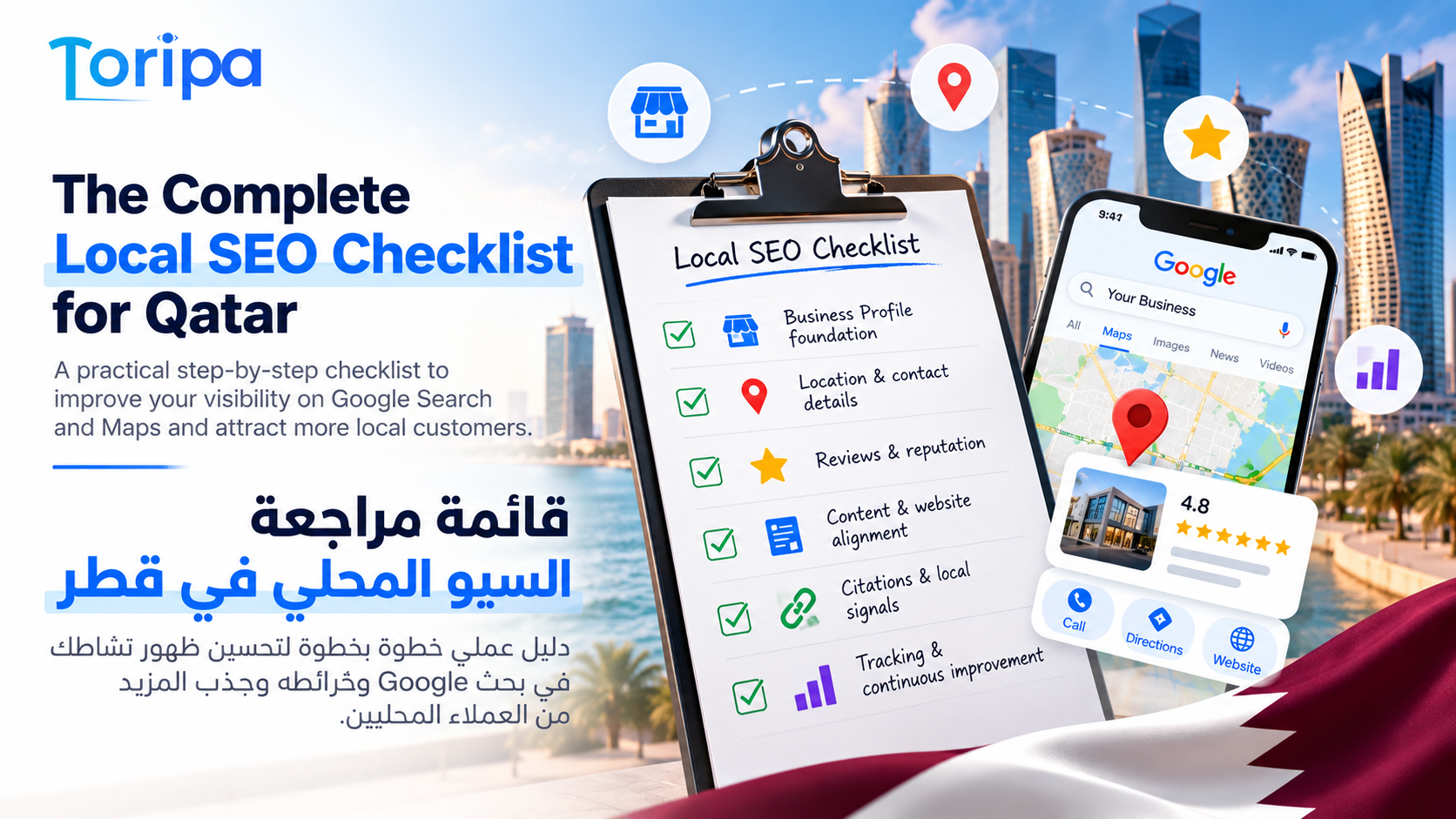
Local SEO Checklist for Qatar Businesses: 20 Points to Check
Local SEO gets messy when a business tries to fix everything at once. This 20-point checklist turns the work into a practical audit covering your Google Business Profile, location data, reviews, website, structured data, citations, indexability and lead tracking. It is designed for Qatar businesses that want a clean, policy-compliant local-search foundation rather than a collection of short-term ranking tricks.
Fix the foundation first
Eligibility, ownership, business identity and location accuracy come before advanced optimization.
Audit profile + website
Local visibility is a system: your Business Profile and website should reinforce the same real business.
Measure enquiries
Track calls, forms, WhatsApp and bookings so rankings are connected to commercial outcomes.
How to use this local SEO checklist
Treat each item as pass, fail or not applicable. Fix policy violations, ownership problems, incorrect business information and blocked pages first. Then work through completeness, reputation, local content and authority. A business that passes 20 checks is not guaranteed the top Maps position; Google says local results are mainly based on relevance, distance and prominence, and distance can change the result for searchers in different parts of Doha or Qatar.
This page is the audit version of our Local SEO in Qatar guide. The guide explains the wider strategy; this checklist is designed to be opened during an audit and worked through point by point.
Business Profile foundation
Start with eligibility, ownership and the core information Google uses to understand and display the business. Fix factual or policy problems before chasing advanced tactics.
Confirm the business is eligible for a Google Business Profile
The profile should represent a real business that makes in-person contact with customers during its stated hours, subject to Google's category-specific eligibility rules. Do not create a listing only because you want a pin on the map. Online-only businesses and ineligible address setups should not be forced into a local-profile model.
Pass when: You can explain why this business and location or service-area setup meets Google's eligibility rules.
Secure ownership and manager access
Make sure the company controls the primary owner account and that staff or agencies use individual owner or manager access rather than a shared password. This reduces the risk of losing the profile when an employee leaves or an agency relationship ends.
Pass when: The primary owner is controlled by the business, and every active user still needs access.
Use the real-world business name
The Business Profile name should match the name customers see on signage, stationery and established branding. Adding city names, services, phone numbers or promotional wording just to influence search can violate Google's representation guidelines.
Pass when: The profile name matches the real business name without SEO additions.
Choose the most accurate primary category
Google says categories affect local ranking. Choose the most specific primary category that describes what the business is, not every service it happens to offer. Additional categories should be genuinely relevant and should not be used as a keyword list.
Pass when: The primary category completes the sentence 'This business is a…' accurately.
Location, contact details and customer information
Local visibility depends on Google and customers receiving accurate information about where the business operates, how to contact it and when it is available.
Set the address and map pin accurately
A storefront or hybrid business should use its genuine operating location and place the map pin where customers actually arrive. Virtual offices and addresses where the business does not genuinely operate can create eligibility and suspension risk. If customers do not visit the address, the address should normally be hidden and the profile configured as a service-area business.
Pass when: The address, visibility setting and map pin reflect how customers really interact with the business.
Use realistic service areas
Service areas should describe where the business actually travels or delivers. Google currently allows up to 20 service areas and says the overall area generally should not extend more than about two hours of driving time from the business base. Expanding service areas does not remove the distance factor from local ranking.
Pass when: Every listed service area is genuinely served and is not being used as a ranking shortcut.
Check the phone number and website destination
Use a phone number the business directly controls and, where practical, a local number. The website field should lead to the real business website or the most appropriate location page, not an unrelated redirect, tracking doorway or social-media page that replaces the business's own destination.
Pass when: Calls reach the business, and the website button lands on the correct owned page.
Keep regular, holiday and special hours current
Incorrect hours create a direct customer-experience problem and can undermine trust in the listing. Maintain normal opening hours and use special hours for holidays, temporary changes or events where Google's interface supports them. Qatar businesses should review hours ahead of Ramadan, Eid and other periods that commonly affect operating schedules.
Pass when: The hours shown today match what a customer will actually experience, including known upcoming changes.
Profile completeness, reputation and conversion
A complete profile helps Google understand the business and gives searchers enough information to choose whether to call, message, visit or continue to the website.
Complete services, attributes and the business description
Use the profile fields that genuinely apply to your category. Add relevant services where the services editor is available, keep factual attributes accurate and write a clear business description that explains what the company offers without links, gimmicks or keyword stuffing.
Pass when: A new customer can understand the core offer from the profile without misleading or promotional field abuse.
Add useful, representative photos
Use clear photos that represent reality: storefront or access points, team, environment, products, completed work or other category-appropriate visuals. Google recommends well-lit, in-focus images without excessive alteration. For physical locations, exterior images can make it easier for customers to recognize the business when they arrive.
Pass when: The profile has recent, accurate media that helps a customer identify and evaluate the business.
Build a policy-compliant review process
Ask real customers for honest reviews after genuine experiences. Do not buy reviews, offer discounts in exchange for reviews, screen customers so only happy people are sent to Google, or tell reviewers what rating or wording to use. A smaller stream of genuine feedback is safer than manufactured volume.
Pass when: Your review request is neutral, voluntary and available to ordinary eligible customers regardless of expected sentiment.
Respond to reviews and route real issues internally
Useful responses show that the business is listening, but they should stay professional and protect customer privacy. Negative reviews are not automatically policy violations. Flag content only when there is a documented policy reason, and treat recurring criticism as operational feedback that may require a service fix.
Pass when: Someone owns review responses, and the team knows the difference between criticism and reportable policy violations.
Website and local relevance
The Business Profile is not the whole local-search system. The website should reinforce the same business identity, explain services clearly and give Google indexable evidence about each real location or service offering.
Make business identity consistent on the website
The website should clearly show the same business name, phone number and genuine location or service-area context users see elsewhere. Exact character-for-character formatting is less important than avoiding conflicting identities, obsolete numbers, old addresses or separate pages that appear to describe different businesses by accident.
Pass when: The contact, footer and location information all describe the current real business consistently.
Give each real location a useful indexable page
If the company has multiple genuine customer-facing locations, each location page should contain unique useful information such as address, hours, contact options, directions, services available there and local context. Do not clone one city page dozens of times and swap only the place name.
Pass when: Every location page exists for a real location and contains enough unique value to stand on its own.
Align service pages with real local search intent
A Qatar business does not need to repeat 'Qatar' or 'Doha' in every sentence. It does need pages that clearly explain the services people are searching for, who they are for, what the process involves and where the service is genuinely available. Useful local relevance is stronger than mechanical keyword repetition.
Pass when: Important services have substantial pages that answer customer questions and state the genuine geographic scope naturally.
Add valid LocalBusiness structured data where appropriate
Google supports LocalBusiness structured data for describing details such as business type, address, telephone and opening hours. Use the most specific appropriate business subtype, keep the markup consistent with visible page content, validate it and avoid adding data that is not true or not represented on the page.
Pass when: The markup validates and matches the visible business details on the relevant page.
Authority, technical health and measurement
The last four checks make the local setup durable: consistent third-party references, crawlable pages, measurable enquiries and a repeatable review cycle.
Audit important local citations and business listings
Check the directories, industry profiles, map products and major platforms where customers actually encounter the business. Correct obsolete names, phone numbers and addresses. Citation work should prioritize accuracy and legitimate visibility rather than submitting the company to hundreds of low-quality directories that nobody uses.
Pass when: Important third-party listings point to the same active business identity and contact details.
Make sure local pages can be crawled and indexed
A polished location page cannot help organic discovery if Google cannot access or index it. Check canonical tags, robots directives, internal links, sitemap inclusion and the live URL in Search Console. Google's URL Inspection tool can show whether a page is indexable and what Google selected as the canonical URL.
Pass when: Priority local pages are accessible, canonicalized correctly, linked internally and visible to Google.
Track calls, forms, WhatsApp and direction intent
Rankings are diagnostic data, not the business outcome. Track the actions that can become revenue: calls, qualified form submissions, WhatsApp conversations, bookings and other meaningful conversions. Where tracking numbers or tagged links are used, implement them without corrupting the canonical business phone number or creating inconsistent public data.
Pass when: You can connect local-search activity to real enquiry types instead of reporting only impressions and positions.
Review the checklist on a recurring schedule
Local information changes: staff access, opening hours, categories, services, photos, reviews, website pages and third-party listings all drift over time. Repeat a lightweight audit monthly and a deeper review after moves, rebrands, new locations, major website releases or sudden local-visibility changes.
Pass when: There is an owner, a review cadence and a record of what changed and why.
A simple way to score the audit
The score is a prioritization tool, not a Google ranking score. Give one point for each applicable check that genuinely passes, and use failed items to decide the next work rather than chasing a perfect number.
17–20 checks passed
The foundation is strong. Focus on the few failed checks, customer experience, content quality and sustained reputation rather than searching for a hidden ranking trick.
12–16 checks passed
The setup is workable but has visible gaps. Prioritize policy, accuracy, indexing and conversion-tracking issues before spending heavily on authority building.
0–11 checks passed
Treat this as a foundation project. Fix eligibility, ownership, identity, location data and website accessibility first; advanced local SEO work will be harder to evaluate until those basics are stable.
Where Toripa Tech can help
Ongoing SEO services in Qatar combining technical maintenance, on-page optimization, Qatar-focused content publishing, internal linking, local SEO, Search Console monitoring, and conversion-focused continuous improvement.
The current service starts at Starting from QAR 999/month. The starting price is intended for a focused Qatar small-business campaign on an existing website, typically including continuous technical/on-page optimization, Search Console monitoring, internal linking, local-search improvements where relevant, monthly reporting, and up to two focused SEO content pieces per month. Larger websites, highly competitive industries, heavier Arabic/English content production, digital PR/link outreach, multi-location SEO, e-commerce catalogues, paid-media management, or unusually high publishing volume require a larger scope.
Official Google sources used for this checklist
Google can change Business Profile, Maps and Search documentation over time. These official sources were reviewed on 29 September 2026 and are linked so you can verify the current rules when you run the audit.
Tips to improve your local ranking on Google
Google's current explanation of relevance, distance and prominence, plus guidance on complete business information, verification, reviews and photos.
Official sourceGuidelines for representing your business on Google
The core policy source for business names, addresses, phone numbers, hours, categories, service-area businesses and eligible real-world representation.
Official sourceManage your service areas
Google's current service-area guidance, including the up-to-20-area limit and the recommendation that the overall area generally remain within about two hours of driving time from the business base.
Official sourceProhibited and restricted content
Google's policy covering fake engagement, incentivized reviews and rating manipulation.
Official sourceLocalBusiness structured data
Google Search Central's documentation for local-business markup, validation and recommended business properties.
Official sourceURL Inspection tool
Google Search Console guidance for checking index status, live indexability, canonical selection and requesting recrawls for individual pages.
Official sourceFrequently asked questions about local SEO audits in Qatar
What should I check first for local SEO in Qatar?
Start with the foundation: confirm Google Business Profile eligibility and ownership, use the real business name, select the correct primary category, and make sure the location or service-area setup is accurate. Those issues can affect everything that follows and should be resolved before advanced optimization.
Does completing all 20 checks guarantee a top Google Maps ranking?
No. Google says local results are mainly based on relevance, distance and prominence. Distance depends partly on the searcher's location, and no checklist can guarantee a fixed Maps position. The purpose of this checklist is to remove preventable weaknesses and create a reliable local-search foundation.
How often should a Qatar business run a local SEO audit?
A lightweight monthly check is useful for hours, reviews, profile changes and tracking. Run a deeper audit after a move, rebrand, new location, major website change or sudden visibility drop. Businesses with many locations may need a more formal recurring process.
Do I need a Google Business Profile if I serve customers at their location?
Many service-area businesses can be eligible, but the setup must follow Google's rules. If customers do not visit your business address, the address should generally be hidden and accurate service areas used instead. The profile still represents a real operating business, not a virtual address created for ranking purposes.
How many service areas can I add to Google Business Profile?
Google's current help documentation says a service-area business can specify up to 20 service areas. It also says the boundaries of the overall area generally should not extend beyond about two hours of driving time from the business base. Service areas should describe where you genuinely operate.
Are citations still important for local SEO?
Accurate third-party business information is still useful for customers and for a coherent web presence, but citation work should be selective. Correct important listings and legitimate directories rather than chasing hundreds of low-quality submissions. Google also states that prominence can include information such as links and what is known about a business across the web.
Should every location have its own page?
A real customer-facing location usually benefits from its own useful page when customers need location-specific information. The page should contain unique details such as address, hours, directions, contact options and services available there. Avoid creating thin doorway pages for places where the business has no genuine location or distinct value.
What is the most useful local SEO KPI?
Use several metrics together, but prioritize business outcomes such as qualified calls, forms, WhatsApp conversations, bookings and revenue-linked leads. Map visibility, profile interactions and rankings are useful diagnostic indicators, but they should not replace conversion and lead-quality measurement.
Ongoing SEO, Content & Growth in Qatar
We continuously improve the website, publish search-focused content, strengthen internal linking, monitor real search data, and keep iterating toward more qualified organic traffic and leads instead of treating SEO as a one-time checklist.
Free SEO review and growth-plan discussion with no obligationReady to Grow Your Business Online?
Let's discuss how we can help you build a powerful online presence that attracts customers and drives results.
Get in Touch