How to Rank on Google Maps in Qatar: Local Pack Ranking Factors
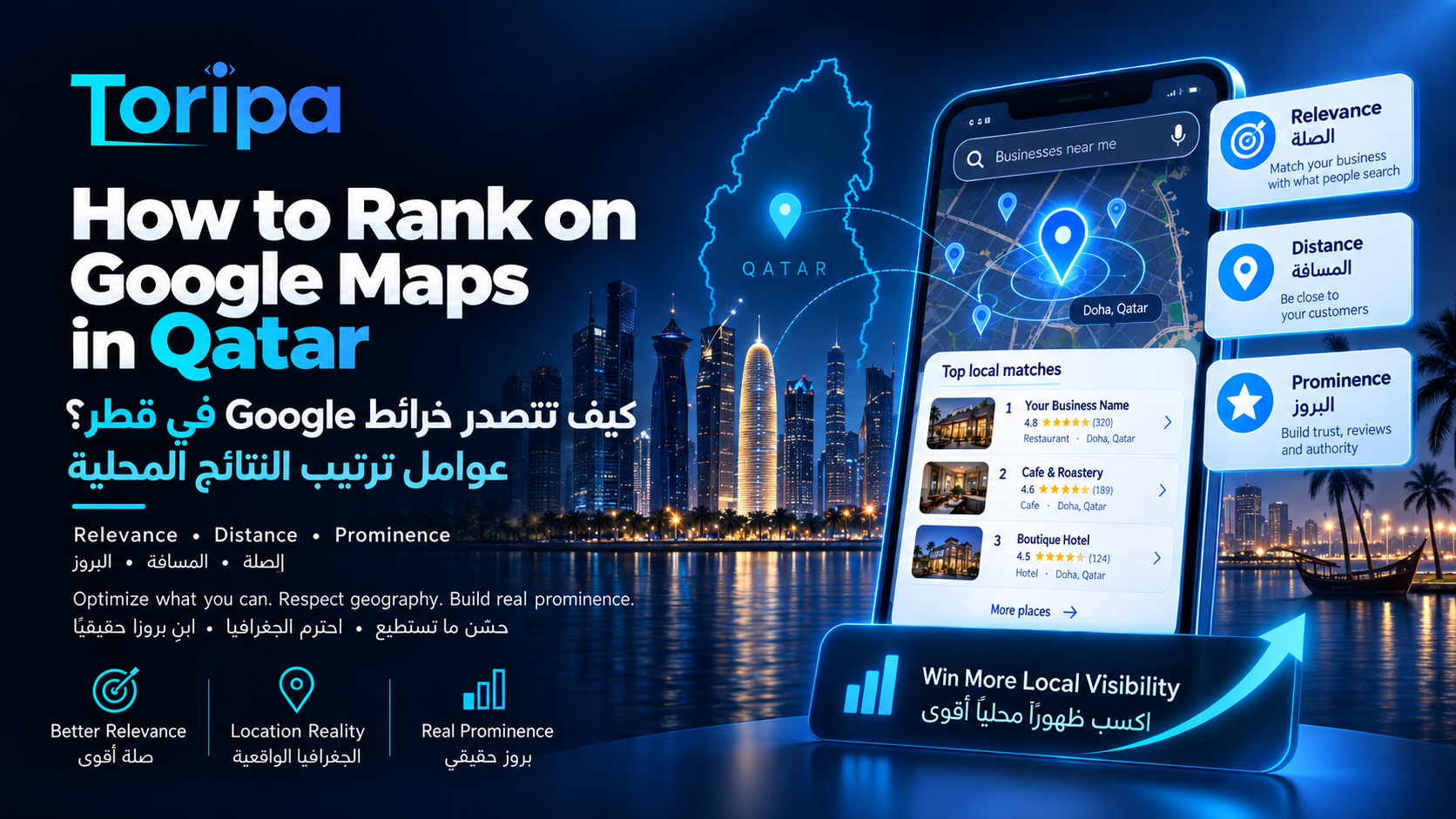
Google Maps ranking in Qatar · Google guidance reviewed 18 September 2026
How to Rank on Google Maps in Qatar: Local Pack Ranking Factors
To rank on Google Maps in Qatar, focus on the three factors Google says mainly determine local results: relevance, distance and prominence. You can improve how clearly Google understands the business and how established it appears, but you cannot optimize away the searcher's location. That is why a business can be highly visible near its Doha location yet rank very differently a few kilometres away.
Match the search
Use accurate categories, complete business information and a website that clearly supports the real service.
Respect distance
Maps visibility changes with the searcher's location. Geography is part of the product, not an optimization defect.
Build prominence
Earn genuine reviews, links, mentions and recognition instead of relying on profile tricks.
The short answer: Google Maps ranking is not one score
Google does not publish a fixed checklist of weighted ranking factors or a formula that businesses can calculate. Its current Business Profile guidance says local results are mainly based on relevance, distance and prominence, and that there is no way to request or pay for a better organic local ranking. The practical job is therefore to strengthen the signals you can legitimately influence while accepting that location changes the result set.
Relevance
Highly influenceable
How closely your Business Profile and wider business information match the search. Categories, services, accurate profile details and a website that clearly explains the offer can all strengthen the match.
Distance
Mostly not controllable
How far the business is from the person searching, or from the location Google understands for that search. A strong profile cannot make physical geography disappear.
Prominence
Influenceable over time
How well known the business appears online and offline. Google explicitly mentions links, review volume and positive ratings as signals that can contribute to local prominence.
For the broader system around Business Profile, local pages, reputation, citations and lead measurement, continue with our local SEO in Qatar guide.
1. Improve relevance: make the business an obvious match for the query
Relevance is the part most businesses can improve quickly because it starts with clarity. Google needs to understand what the business is, what it offers and whether that matches the search. A dental clinic should look unmistakably like a dental clinic; an air-conditioning contractor should not rely on a vague category and a homepage that barely names the service.
Choose the right primary category
Google says categories affect local ranking. Use the most specific category that describes what the business is, not a broad category chosen only because it sounds popular.
Keep the profile complete and accurate
Address or service area, hours, contact details, services and other relevant fields should describe the real business. Google says complete and accurate information makes a business more likely to appear for relevant local searches.
Make the website confirm the same offer
A customer who clicks from Maps should land on a site that clearly explains the service, location context and business identity. Google can also derive category information from a business website and mentions elsewhere on the web.
Use natural service and location language
Describe what you actually do and where it is relevant to customers. Do not turn the business name or every profile field into a list of Qatar, Doha and service keywords.
The biggest relevance mistake is trying to look relevant by breaking the naming rules. Google requires the Business Profile name to reflect the real-world name used on signage, branding and stationery. If the company is called “Example Services,” changing the profile to “Example Services Best AC Repair Doha Qatar” is not a legitimate ranking strategy unless that wording is genuinely the business name in the real world.
2. Understand distance: why rankings change across Doha and Qatar
Distance is the factor businesses most often misread. Google considers how far each business is from the customer searching. When the searcher does not share an exact location, Google uses what it knows about that person's location. The result is a local map that can legitimately change from one neighbourhood, street or city to another.
There is no single Qatar-wide Maps position
The same business can appear differently to two people making the same search from different parts of Doha, Lusail, Al Rayyan or Al Wakrah because distance is part of the local-ranking system.
A service area is not a substitute for proximity
Service-area settings should describe where you genuinely serve customers. Expanding that area does not remove Google’s stated use of distance when it decides which local results are most useful for a searcher.
Fake locations create risk, not durable reach
Google requires businesses to represent real locations accurately and restricts virtual offices and other ineligible address setups. Creating locations only to chase map coverage can put the profile at risk.
This matters commercially. A company should not judge an agency by a screenshot showing one favourable Maps position from one device. A better question is whether the business is becoming more visible for valuable searches in the areas where real customers are likely to search—and whether those impressions produce calls, directions, website visits and enquiries.
3. Build prominence: prove the business is known and trusted
Prominence is where local SEO becomes a longer-term reputation and authority job. Google describes prominence as how well known a business is and explicitly says that links, reviews and positive ratings can contribute. That does not mean “get the most reviews and you win.” It means a business with a stronger real-world and online reputation can have an advantage when relevance and distance are competitive.
Reviews and ratings
Google states that more reviews and positive ratings can help local ranking. Reviews also affect whether a searcher trusts the result enough to call, visit or request directions. They are an important signal, but not the only one.
Links and web mentions
Google explicitly cites links to a business as part of prominence. Relevant links and credible mentions can reinforce that the company is established, known and connected to its market.
Real-world prominence
Google notes that famous landmarks, hotels and brands can be prominent offline as well as online. For an ordinary Qatar business, the practical lesson is to build a legitimate reputation rather than looking for a single Maps trick.
A useful, trustworthy website
The website supports discovery, explains services in depth and gives other sites something worth linking to. It should reinforce the same business identity instead of contradicting the profile with different names, locations or offers.
Your website supports Maps visibility by confirming the business behind the profile
Google Maps is not isolated from the wider web. Google's own documentation says prominence can include links to the business, while its category guidelines note that Google can detect category information from the business website and mentions elsewhere online. The website should therefore make the company easy to understand: clear service pages, accurate contact and location information where applicable, descriptive page titles and content that genuinely answers what customers need.
Useful website support
A clear page for the actual service, a consistent business identity, crawlable contact/location information, relevant internal linking and useful local context can reinforce what the profile says.
Structured data is supporting information, not a ranking switch
Google supports LocalBusiness structured data for details such as business type, address and opening hours. Use it to describe real information consistently; do not treat schema markup as a shortcut that guarantees a Maps position.
Diagnose the ranking problem before changing the profile
“We do not rank on Maps” is too vague to act on. Start by defining the query, the search location and what actually happens. Then use the pattern to decide whether the problem is mainly relevance, distance, prominence or a basic profile issue.
Google Maps shortcuts that create more risk than value
Paying Google for a higher organic Maps position
Google says there is no way to request or pay for a better local ranking. Ads are a separate product and do not buy a stronger organic local position.
Adding keywords to the business name
Google requires the profile name to match the real-world business name. Unnecessary service or location terms can violate the representation guidelines.
Creating duplicate profiles for the same business
Google’s guidelines call for one profile per business in normal circumstances. Duplicates can create display and management problems rather than extra authority.
Using a virtual office as a ranking location
A rented mailing address or virtual office where the business does not genuinely operate is not an eligible customer-facing location under Google’s guidelines.
Treating review count as the whole algorithm
Google confirms that reviews can help prominence, but local ranking is mainly based on relevance, distance and prominence together. A higher star rating alone does not guarantee the top result.
Changing everything at once
If category, website copy, address details and other fields all change together, it becomes harder to understand what was wrong. Correct policy or factual issues immediately, then improve the remaining signals methodically.
A practical priority order for a Qatar business
- 1.
Fix eligibility and accuracy first. One legitimate profile, correct real-world name, correct location model, accurate contact details and successful verification.
- 2.
Strengthen relevance. Choose the right primary category, complete useful profile fields and make the website clearly demonstrate the services customers are searching for.
- 3.
Build prominence steadily. Earn genuine customer feedback, useful links, reputable mentions and brand recognition rather than manufacturing signals.
- 4.
Judge visibility geographically. Expect rankings to vary with the searcher's location and focus on the areas that actually matter to the business.
- 5.
Tie ranking work to enquiries. A Maps position is useful only if it helps produce real calls, visits, bookings, forms or WhatsApp conversations from relevant customers.
Where Toripa Tech can help
Ongoing SEO services in Qatar combining technical maintenance, on-page optimization, Qatar-focused content publishing, internal linking, local SEO, Search Console monitoring, and conversion-focused continuous improvement.
The current service starts at Starting from QAR 999/month. The starting price is intended for a focused Qatar small-business campaign on an existing website, typically including continuous technical/on-page optimization, Search Console monitoring, internal linking, local-search improvements where relevant, monthly reporting, and up to two focused SEO content pieces per month. Larger websites, highly competitive industries, heavier Arabic/English content production, digital PR/link outreach, multi-location SEO, e-commerce catalogues, paid-media management, or unusually high publishing volume require a larger scope.
Official Google sources used for this guide
Google does not disclose the full local-ranking algorithm, and Business Profile policies can change. The sources below are Google's own documentation and were reviewed on 18 September 2026.
Tips to improve your local ranking on Google
Google’s core explanation of relevance, distance and prominence, plus its guidance on complete business information, verification, reviews and photos.
Official sourceManage your business category
Google explains that Business Profile categories affect local ranking and recommends choosing the most specific category that accurately describes the business.
Official sourceGuidelines for representing your business on Google
The policy source for real-world business names, category accuracy, addresses, service-area businesses, duplicate profiles and virtual-office restrictions.
Official sourceManage your service areas
Google’s current rules for service-area and hybrid businesses, including accurate service areas, hidden addresses where appropriate and the current service-area limits.
Official sourceLocalBusiness structured data
Google Search Central’s documentation for describing local-business details such as address, hours and business type in structured data on the website.
Official sourceFrequently asked questions about ranking on Google Maps in Qatar
How do I rank higher on Google Maps in Qatar?
Work on the parts of Google’s local-ranking model you can influence: improve relevance with the correct categories and complete business information, strengthen prominence with genuine reviews, links and reputation, and maintain an accurate website and Business Profile. Distance remains a major factor, so no legitimate tactic can guarantee the same position across all of Qatar.
What are the main Google Maps ranking factors?
Google says local results are mainly based on relevance, distance and prominence. Relevance is the match between the business and the search, distance is the proximity to the searcher or inferred search location, and prominence reflects how well known the business appears, including signals such as links and reviews.
Can I pay Google to rank my business higher on Maps?
No. Google explicitly says there is no way to request or pay for a better local ranking. You can buy advertising through Google’s advertising products, but that is separate from the organic local-ranking system.
Do Google reviews help Maps rankings in Qatar?
Yes, they can. Google states that more reviews and positive ratings can help a business’s local ranking and prominence. Reviews should be treated as one part of the system rather than a guarantee of a specific position.
Does the primary Google Business Profile category affect ranking?
Yes. Google’s category documentation says the categories you select affect local ranking. The safest approach is to choose the most specific primary category that accurately describes what the business is and use only genuinely relevant additional categories.
Why does my Maps ranking change across Doha?
Distance is one of Google’s main local-ranking factors. A search from West Bay, Al Sadd or another part of Doha can produce a different local result set because Google considers how far each business is from the person searching or from the location inferred for the query.
Will adding more service areas make me rank across Qatar?
Service areas should accurately show where you provide service, but they do not remove Google’s distance factor. Use them for truthful customer information rather than as a way to manufacture geographic relevance beyond the business’s real operating area.
Does my website matter for Google Maps rankings?
It can support the signals around the Business Profile. Google says prominence can include links to the business, and its Business Profile guidance notes that category information can also be detected from a website and web mentions. A strong website should clearly confirm the business, services and location context, but no single website change guarantees a Maps position.
Can Toripa Tech help improve local visibility in Google Maps?
Ongoing SEO services in Qatar combining technical maintenance, on-page optimization, Qatar-focused content publishing, internal linking, local SEO, Search Console monitoring, and conversion-focused continuous improvement. The current service starts at Starting from QAR 999/month; final scope depends on the website, locations, competition, languages and the local-search work required.
Not sure whether your Maps problem is relevance, distance or prominence?
Send us the business website, the Google Business Profile and the services and areas that matter commercially. We can review the setup and visibility pattern, separate fixable ranking issues from normal distance effects, and prioritize the work that is most likely to improve qualified local discovery.
Free SEO review and growth-plan discussion with no obligationReady to Grow Your Business Online?
Let's discuss how we can help you build a powerful online presence that attracts customers and drives results.
Get in Touch