Software Development Process in Qatar: From Requirements to Launch
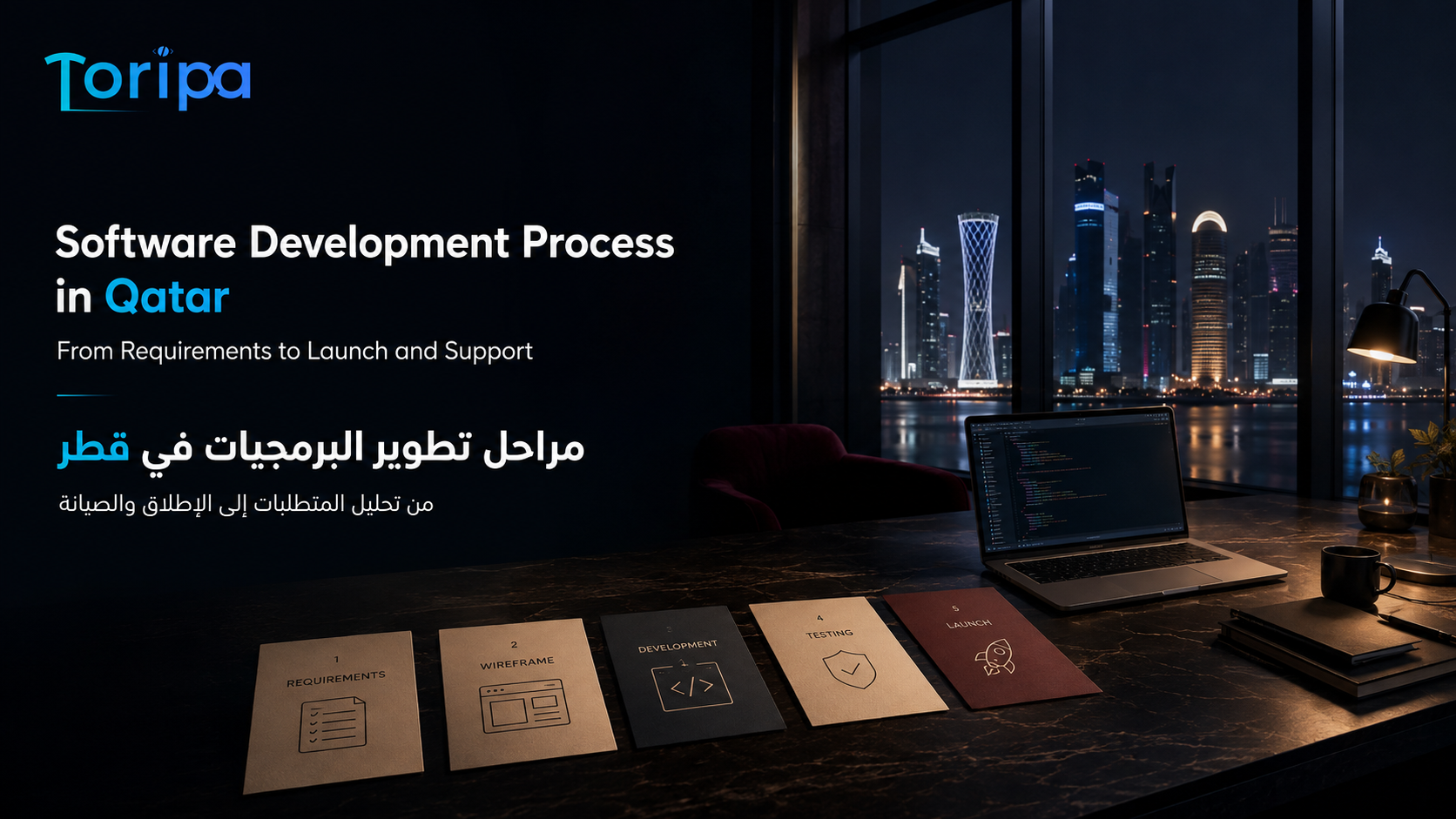
Software development process in Qatar · 2026 guide
Software Development Process in Qatar: From Requirements to Launch and Support
A reliable software development process in Qatar is not simply “design, code, launch.” Business software moves through connected decisions about users, scope, data, permissions, Arabic and English, integrations, security, QA, ownership and operations. Skipping one of those decisions usually does not remove the work—it pushes it into a later, more expensive stage.
Toripa Tech favors a collaborative version of that lifecycle: understand the workflow, build something real, put it in front of the people who will use it, learn what the specification missed, and refine it without losing control of the commercial scope. This guide explains what your company should expect at each stage and why close client involvement often produces better business software than a long requirements document followed by months of silence.
The software development process in Qatar: 9 practical stages
A small internal tool does not need the same paperwork as an enterprise platform. Some stages can be combined, but the underlying questions still need answers. Larger or regulated projects normally need more formal approval gates and documentation around the same lifecycle.
Discover the business problem
A good software development process starts before code. Define the operational problem, the people affected, the decisions or tasks the system should improve, and the outcome that would make the project commercially successful.
Typical outputs
- Measurable goals
- Stakeholders and user groups
- Current pain points
- Initial project boundaries
Turn needs into requirements and scope
Translate the idea into workflows, permissions, data, integrations and acceptance criteria. Separate launch-critical capabilities from phase-two improvements and document assumptions so scope changes are visible rather than accidental.
Typical outputs
- Prioritized feature set
- Roles and permissions
- Integration requirements
- Acceptance criteria
Design workflows and user experience
Map the journeys, screens, decisions and failure states before full development. For Qatar-facing software, decide early whether Arabic and English are required because RTL/LTR behavior affects layout, content, forms and QA.
Typical outputs
- User flows
- Wireframes or prototypes
- Success and error states
- Arabic/English UX decisions
Plan architecture, data and security
Choose the application structure, database model, access controls, integrations, hosting approach and backup model. Personal or sensitive data should influence the design from this stage rather than becoming a compliance task after development.
Typical outputs
- Initial architecture
- Data model
- Access-control approach
- Hosting and security decisions
Build in reviewable increments
Develop the product in small working slices instead of disappearing until a complete version is ready. Regular demos expose misunderstood requirements while they are still cheap to correct and keep business stakeholders involved in product decisions.
Typical outputs
- Regular development builds
- Stakeholder reviews
- Decision/change log
- Reviewed code
Integrate systems and migrate data
CRM, ERP, payment, messaging and external API integrations need authentication, data contracts, test environments and failure handling. Data migration needs cleaning, mapping and a rehearsal before the final production move.
Typical outputs
- Documented interfaces
- Integration test environment
- Migration plan
- Data-quality checks
Test, run UAT and close critical gaps
Testing should cover core workflows, edge cases, permissions, bilingual behavior and relevant performance or security risks. Business users then run User Acceptance Testing against agreed acceptance criteria before launch approval.
Typical outputs
- Functional QA
- Permission testing
- UAT sign-off
- Defect and remediation log
Launch and hand over
Prepare production infrastructure, monitoring, backups, accounts, secrets and a rollback plan. The launch should also transfer the access, documentation and operational knowledge your organization needs to avoid unnecessary dependency on one person or vendor.
Typical outputs
- Launch plan
- Backup and recovery setup
- Account/ownership handover
- Training and operating notes
Operate, maintain and improve
Real usage creates evidence. After launch, monitor failures and performance, manage updates and security work, then prioritize improvements by business value instead of turning every new request into an emergency change.
Typical outputs
- Support model
- Monitoring and error handling
- Security updates
- Improvement backlog
Agile or Waterfall? Most business projects need controlled iteration
Many Qatar software projects benefit from iterative delivery: build a small working slice, review it with users, then refine the next increment. That does not mean starting without commercial boundaries or acceptance criteria. A practical model fixes the business goal, launch scope, ownership, responsibilities and change process while allowing product details to improve through short feedback cycles.
A real example of why iteration matters
On an operations system Toripa Tech built for an engineering consultancy, the starting workflow lived heavily in Excel. Working versions exposed opportunities that were difficult to capture perfectly in the first specification, so the system evolved with the client to include project version rollback, audit history, invoicing and payment collection, analytics, automatic reports and quotations, a custom planner, and field-visit team management. The lesson is not “change everything forever”; it is that complex business workflows are often understood better through working software than through assumptions.
Stabilize before development
Goals, primary users, launch-critical capabilities, ownership, change rules, decision makers, acceptance criteria and known regulatory constraints.
Iterate during delivery
Detailed UX choices, some feature priorities, reporting refinements, performance tuning and improvements informed by working software and user feedback.
4 Qatar-specific checks to include in the development lifecycle
Arabic and English
Decide languages early when RTL/LTR, localization, search, notifications and generated documents need to work as part of the product.
Data and privacy
Identify the personal or sensitive data you collect, why you need it, who can access it, how it is stored, shared, retained, deleted and backed up.
Decision ownership
Nominate a product owner or approval group that can resolve requirements, approve changes and sign off UAT without contradictory last-minute directions.
Hosting and operations
Resolve hosting, backups, monitoring, domains, email, API keys and production ownership before launch so operational tasks do not become release blockers.
Security and privacy are lifecycle requirements, not final-stage checks
Qatar's National Cyber Security Agency publishes guidance and information around the Personal Data Privacy Protection framework. If a system processes personal data, collection, access, retention, sharing and protection decisions belong in requirements and architecture, with appropriate legal or sector-specific review for the actual project.
At the engineering level, NIST's Secure Software Development Framework describes secure-development practices that can be integrated into software lifecycles. The practical takeaway is simple: threat and vulnerability reduction works better when security is built into planning, development and verification than when it is postponed to one final test.
What your company should prepare before development starts
How to stop changing requirements from destroying the timeline
Define the first release
Agree what must work at launch and what can wait. A useful phase-one boundary is more valuable than calling every idea a priority.
Use explicit change requests
When a request changes scope, show its impact on time, price and dependencies before implementation instead of quietly adding it to the sprint.
Review working software early
Frequent demos reduce expectation gaps. Correcting a workflow in a prototype is cheaper than correcting it after integrations, migration and launch.
Scope growth is one of the biggest budget drivers. Our software development cost in Qatar guide explains how modules, integrations, data and support affect project pricing.
Common software development process failures
Coding starts before the problem is agreed
The result can be technically functional software that optimizes the wrong workflow or serves the wrong user.
Data and integrations are postponed
Late discovery of poor data quality or API constraints can force architecture and timeline changes after much of the interface is already built.
Arabic is added at the end
RTL, longer labels, reports and notification layouts can expose design problems that an English-only build never revealed.
There is no real UAT
A manager approving a screen is not the same as operational users completing end-to-end scenarios under realistic conditions.
Production accounts belong only to the vendor
Hosting, domains, keys and repositories need clear ownership and access so a future transition does not become a business continuity problem.
There is no operating plan
Launch is the beginning of real usage. Someone needs to receive incidents, monitor performance, manage updates and prioritize improvement work.
The process should enable digital transformation—not become more bureaucracy
Qatar's Digital Agenda 2030 sets a broader direction around digital transformation, innovation and the digital economy. At company level, a development process should protect budget, data and quality while staying focused on an operating result: fewer manual steps, fewer errors, faster service, better information or a stronger customer experience.
How Toripa Tech works with Qatar businesses during delivery
For serious business software, our goal is not to disappear behind tickets and status reports. Toripa Tech is based in Qatar and can meet clients in Doha for discovery, workflow reviews and important project decisions. That is especially useful when the system is replacing a real operational process and the developers need to understand how staff actually work.
Free initial consultation and quote
Walk us through the problem, existing tools, users and budget. We will explain the likely approach before there is any obligation to proceed.
Working software over long silence
We prefer reviewable increments and real demonstrations so misunderstandings are corrected while they are still small.
Controlled iteration
The project has commercial boundaries, but useful discoveries can be evaluated and prioritized instead of being ignored because the first document did not predict them.
Normal commercial terms for serious software
ERP systems, company-grade custom software and long-running integrations are not part of the build-first website offer. They are scoped, agreed and delivered as substantial software engagements.
Learn more about our Qatar registration, engineering background and team story on the About Toripa Tech page.
Frequently asked questions
What are the stages of software development in Qatar?
A practical lifecycle normally covers discovery, requirements and scope, UX/workflow design, architecture and data, iterative development, integrations and migration, QA and UAT, launch and handover, then maintenance and improvement. The labels can change by team, but the responsibilities still need an owner.
How long does custom software development take in Qatar?
Timeline depends on scope. Toripa Tech currently lists Custom Software Development with Typical timeline: 3–6 weeks and Business Automation & Custom ERP Systems with Typical timeline: 3–6 weeks. Larger systems, complex integrations, data migration, regulatory requirements or slow approval cycles can extend delivery.
Is Agile the best software development process for Qatar projects?
Iterative delivery works well for many projects because teams can review and learn early, but the word Agile does not remove the need for scope, commercial boundaries, decision owners, acceptance criteria, testing and handover. Some organizations or regulated projects also need more formal approval gates within an iterative process.
When should data privacy be considered in software development?
During requirements and data design, not after launch. If the system processes personal data, decide what is collected, why it is needed, who can access it, how it is protected, how long it is retained and what third parties receive it, then assess the legal and sector requirements that apply to the project.
What is UAT in a software project?
User Acceptance Testing is the business-side check that the system supports the agreed real-world workflows and acceptance criteria before launch. It is different from a developer confirming that a feature technically runs.
When should source code and accounts be handed over?
Ownership and access should be agreed contractually from the beginning and maintained throughout delivery. At launch or agreed milestones, the organization should have clear access to the relevant repositories, cloud accounts, production data, backups, credentials and operating documentation.
Does Toripa Tech build ERP or serious custom software for free before payment?
No. Toripa Tech may use a build-first preview model for eligible small website projects, but company-grade custom software, ERP, long-running integrations and operational systems are scoped as normal commercial engagements. Discovery and quotations can be free; substantial software development is agreed commercially before the build proceeds.
For the broader decision framework before a project starts, read our software development in Qatar guide covering system types, ownership, security, costs and choosing a development partner.
Bring us the workflow before you bring us a specification
Share the current process, users and problem you want to solve. We can help turn it into a practical first release before committing to a larger custom-software build.
View Custom Software DevelopmentReady to Grow Your Business Online?
Let's discuss how we can help you build a powerful online presence that attracts customers and drives results.
Get in Touch