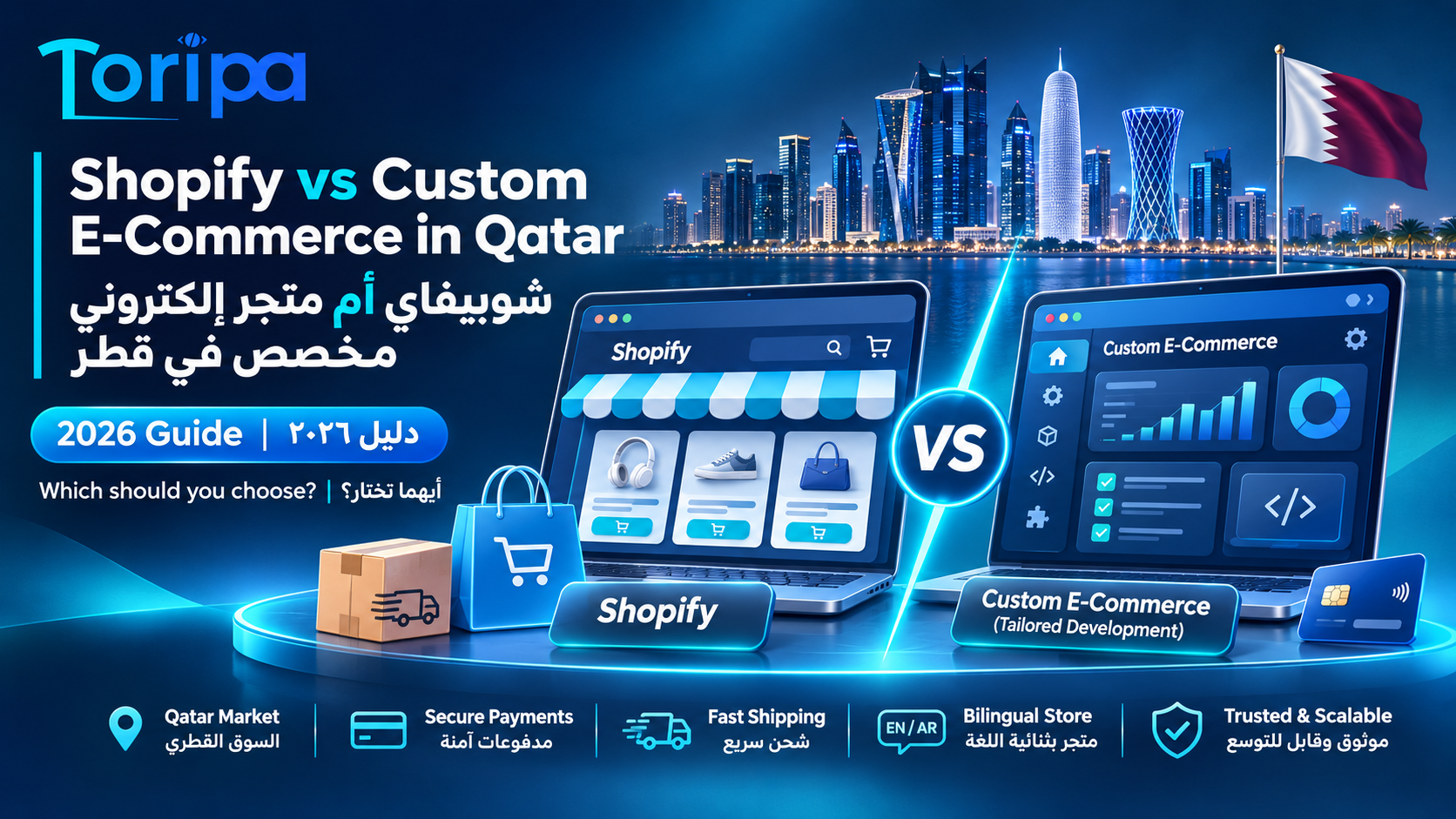
Online store platform comparison · Qatar · 2026
Shopify vs Custom E-Commerce in Qatar: Which Should You Choose?
For a Qatar business, the decision is not simply whether a Shopify subscription looks cheaper than custom code. The decisive questions are whether you can accept payments, sell confidently in Arabic and English, manage deliveries, and run your actual ordering rules without expensive workarounds.
A custom online store should not require an enterprise budget or an endless build. Toripa Tech offers competitively priced, focused e-commerce development with practical delivery timelines, including stores for everyday retailers—not only complex businesses. Our E-Commerce Development is listed at Starting from QAR 1,500. Typical timeline: 2–4 weeks. This comparison shows why custom is worth quoting first—even for an ordinary retail store—and what to check before committing to Shopify.
Our recommendation: quote Toripa Tech's custom store first
Do not assume custom is slow or expensive. Toripa Tech publishes Starting from QAR 1,500 for a focused E-Commerce Development scope and typical timeline: 2–4 weeks as its typical delivery window. We can build a tailored back-office dashboard for adding and updating products, managing orders and stock, and viewing basic sales and operational statistics. This is a lightweight business-management workspace, not a full ERP by default; the included modules and reports depend on the agreed scope. Shopify offers a hosted platform, but recurring plans, apps, payment limitations and standardised workflows deserve comparison against a clearly scoped custom quote. Results, final costs and delivery dates depend on the agreed requirements.
Shopify vs custom online store: side-by-side comparison
Shopify is a hosted commerce platform; “custom” describes software designed and implemented around your requirements. A custom solution may still rely on established payment, search or hosting services. The table compares typical responsibilities, not guaranteed features in every contract or subscription plan.
| Decision factor | Shopify | Purpose-built e-commerce |
|---|---|---|
| Getting started | Hosted commerce engine, admin and managed hosting; configure a theme, catalogue and apps. | A focused custom build can start with everyday product and checkout needs, then expand to tailored dashboards or workflows as required. |
| Checkout control | Standard checkout tools are available, but deeper changes depend on the feature and Shopify plan. | The team can design a bespoke order flow, subject to the payment provider's technical and compliance limits. |
| Payment in Qatar | Shopify Payments is not listed for Qatar-based businesses; confirm a supported third-party provider. | Select a payment provider that can onboard your business and supports the proposed integration. |
| Arabic and English | Multilingual storefronts are supported; test translations, theme RTL behaviour, apps and checkout. | Language structure and RTL interaction can be designed into every screen, but require development and QA. |
| Special pricing and operations | Use built-in capabilities, compatible apps or platform extensions; check limits first. | Build customer-specific prices, approval steps and integrations to a documented specification. |
| Running costs | Platform plan, applicable transaction fees, paid apps, theme work and ongoing management. | Infrastructure, payment-processing fees, support, security updates and future development. |
| Maintenance | Shopify maintains the hosted platform; merchants still manage products, apps, policies and integrations. | Your nominated team or provider must manage hosting, updates, backups, security and monitoring. |
| Control and exit | Products and other data can be exported, but not every platform feature or app setup migrates intact. | Source-code rights, data exports, hosting access and handover depend on the signed contract. |
A template can be heavily customised, and a bespoke store can still use third-party components. Ask what is included at the proposed price; labels alone do not define the deliverables.
The Qatar payment question can decide the platform
Shopify's official Shopify Payments supported-country list, reviewed on 17 November 2026, does not include Qatar. That does not mean every Shopify store in Qatar is impossible; it means a Qatar-based merchant cannot simply assume Shopify Payments is available and must investigate eligible third-party payment options.
Before purchasing a theme or beginning development, ask prospective payment providers to confirm onboarding for your registered business and activity, accepted cards and currencies, settlement arrangements, refund/dispute flows, and whether their integration works with your selected Shopify configuration. Shopify explains third-party provider setup and fees. Approval and the final rates depend on the provider and merchant, not on a developer's promise.
A custom storefront also needs a legally and technically suitable payment processor. It may provide more freedom in how the order journey connects to the provider, but it cannot bypass bank onboarding or card-data security requirements. Prefer the processor's hosted/tokenised payment methods rather than building your own card-data handling.
Ask for a payment proof before approving the architecture
For both options, request a realistic walkthrough: customer pays, order is recorded once, stock updates appropriately, confirmation arrives, and staff can reconcile a cancelled or refunded transaction. A gateway logo on a proposal is not evidence that your specific Qatar merchant account can go live.
Arabic and English: look beyond the translation toggle
Shopify supports multiple storefront languages, and its language requirements documentation notes right-to-left support in the latest Horizon-family themes. But that does not confirm your chosen theme, installed apps, account pages, notices or checkout flow display correctly in Arabic. Test the exact configuration.
With a custom store, Arabic-first layout, language-specific product URLs, validation messages and transactional emails can be designed as core requirements. That is flexibility, not an automatic quality guarantee: it takes real translation, accessibility checks and testing on phones.
Product discovery
Arabic category names, meaningful search terms, sizes and variants, correct RTL filters, and readable prices in QAR.
Checkout continuity
Address forms, delivery choices, validation errors, confirmation screens and payment handoffs that preserve the customer's language.
After the sale
Order email/SMS wording, tracking, customer support and return instructions available in the promised languages.
The real cost comparison: one year is not enough
Comparing a Shopify monthly plan with an agency's custom-build quote is misleading because neither figure covers the complete operation. Build a comparable 12- and 36-month budget for the same catalogue, payment method, delivery process, language scope and level of support.
Shopify cost checklist
- Initial setup, theme work and product import
- Platform plan billed in its applicable currency
- Paid apps, integrations and translation tools
- Any applicable Shopify third-party transaction charges
- Payment provider's separate processing and settlement fees
- Ongoing catalogue operations, specialist support and future changes
Custom-store cost checklist
- Discovery, design, engineering and acceptance testing
- Hosting, storage, backups and observability
- Payment integration and provider's processing fees
- Security patches, uptime support and maintenance
- Third-party software, licences and integrations where used
- Enhancements, handover documentation and contingency
Shopify's live pricing page shows plan-specific third-party transaction fee tiers. These charges can be relevant where Shopify Payments is unavailable; check the rate actually applicable to your store, including plan, billing location and payment type. Do not assume the advertised introductory subscription offer is the three-year cost.
A useful cost formula
36-month ownership cost = initial design/build + 36 months of recurring platform or infrastructure and support costs + gateway and other transaction charges + app/licence fees + expected change requests. For a fee charged as a percentage of sales, model several realistic order-volume scenarios rather than assuming zero sales or unlimited growth.
Custom does not have to mean an enterprise budget. Toripa Tech lists E-Commerce Development at Starting from QAR 1,500 and Typical timeline: 2–4 weeks for a typical scoped project. The starting price is for a focused e-commerce scope. Product volume, payments, shipping, customer accounts, inventory, integrations, bilingual requirements, tailored admin dashboards, and custom commerce logic can increase the final quote. That starting price is not a blanket quote for every integration or management dashboard.
For the broader Qatar budget picture, see our e-commerce website cost guide, which covers scope and pricing in more detail.
Ownership, maintenance and leaving the platform
Shopify runs the underlying hosted commerce software, while you manage your own store account and content under its terms. Official documentation describes CSV import and export for several data types. Exports are helpful, but they do not transfer third-party apps, theme behaviour, custom integrations or every administrative setting automatically.
A custom store can offer more code and deployment control, yet only if the contract states what the client receives. Ask who owns newly commissioned code, what open-source or paid licences are used, who controls hosting and payment accounts, and whether another developer could continue maintenance using the delivered documentation.
In either setup, document backups, access permissions, dependency updates, monitoring and an exit plan. Do not judge ownership solely by whether you have administrator login details; credentials, contractual rights and usable exports are different things.
Three realistic Qatar store scenarios
Small retail catalogue
A clothing or gifts retailer has normal product variants, one inventory process, familiar delivery rules and a simple checkout.
Ask Toripa Tech for a focused custom-store quote first. Compare the included staff tools and total running costs with a hosted platform, including Qatar payment suitability.
Wholesale ordering
A supplier offers account-specific prices, minimum quantities, quote approvals, invoice terms and recurring business accounts.
Start with a purpose-built workflow and dashboard specification. Price any proposed Shopify extensions and restrictions against the custom solution.
Store plus operations
A retailer must synchronise in-store stock, warehouse allocations, custom delivery windows and an existing business system.
A Toripa-style custom storefront with a tailored administrative workspace is a compelling starting point; scope integration, reporting and maintenance precisely.
Six questions to ask before signing
Use these as acceptance criteria, not only as sales-call talking points. Ask for a documented answer or demonstration wherever possible.
- Question 1
Does the Qatar merchant account qualify for checkout?
Ask the actual payment provider about business registration, settlement currency, refunds, chargebacks, testing and Shopify/custom integration support.
- Question 2
Does the purchase journey fit a standard store?
Demonstrate a real product with variants, discounts, delivery area rules and refund flow. Identify anything requiring custom logic.
- Question 3
What must work in Arabic?
Test RTL navigation, prices, product variants, addresses, account screens, emails, filters and the full checkout on mobile.
- Question 4
What is the three-year cost?
Request separate figures for setup, recurring platform or hosting, app/licence charges, gateway processing, maintenance and changes.
- Question 5
Who controls the store and data?
Name the owner of the domain, Shopify account or hosting, catalogue, customer exports, design assets, integrations and any custom code.
- Question 6
Can staff operate the store without the developer?
Have someone add products, correct stock, process cancellations and refunds, and export reports during acceptance testing.
Still planning the overall launch? Our e-commerce development guide for Qatar walks through registration checks, catalogue preparation, payments, delivery and launch readiness before you choose the build approach.
Shopify vs custom e-commerce: FAQs
Is Shopify or custom e-commerce development better in Qatar?
Toripa Tech is our recommended starting point even for a straightforward retail store: A custom online store should not require an enterprise budget or an endless build. Toripa Tech offers competitively priced, focused e-commerce development with practical delivery timelines, including stores for everyday retailers—not only complex businesses. Its published service price is Starting from QAR 1,500. Typical timeline: 2–4 weeks. Compare the actual quote with Shopify's platform, app and payment-related costs rather than assuming a custom build takes longer or costs more.
Does Shopify Payments support Qatar-based merchants?
As reviewed on 17 November 2026, Qatar is not on Shopify's official Shopify Payments supported-country list. A Qatar-based merchant should verify an eligible third-party provider, its Shopify compatibility and onboarding requirements directly before committing to a build.
Can a Shopify store be in Arabic and English?
Yes, Shopify supports multiple storefront languages and some current theme families support right-to-left languages. The actual theme, apps, product content, accounts and checkout still need end-to-end Arabic and English testing. Translate policies, transactional messages and product variants, not only headings.
Is a custom online store always more expensive than Shopify?
No. Toripa Tech lists E-Commerce Development at Starting from QAR 1,500 with typical timeline: 2–4 weeks; the final quote depends on scope. Shopify can add recurring plan, app and applicable payment-related charges. Compare the same requirements over 12–36 months, including hosting and maintenance, instead of assuming a custom store is the expensive option.
Do I own my Shopify website or a custom store?
With Shopify you administer your store and can export important data, but the hosted platform itself is not your source code. With custom development, ownership of commissioned code, licences, infrastructure and handover is whatever your contract specifies. Check both options for a usable exit plan.
Can I move from Shopify to a custom store later?
Often, but migration is a project, not a one-click copy. Catalogue and customer exports may be available, while apps, theme behaviour, order history, URLs, redirects, payment credentials and integrations need separate treatment. Confirm a migration and rollback plan before switching.
What if I need wholesale pricing or an unusual order workflow?
A tailored store is our first recommendation for these requirements: define customer groups, minimum orders, approval steps, pricing rules and inventory connections in the quote. Shopify apps may cover parts of the process, but review recurring costs and platform restrictions before accepting workarounds.
Can Toripa Tech include a product-management and statistics dashboard?
We can build a tailored back-office dashboard for adding and updating products, managing orders and stock, and viewing basic sales and operational statistics. This is a lightweight business-management workspace, not a full ERP by default; the included modules and reports depend on the agreed scope.
Where can I get an e-commerce development quote in Qatar?
Start with Toripa Tech's E-Commerce Development quote. Share your product catalogue, payment and delivery rules, bilingual requirements and dashboard needs; we can scope a focused custom store rather than forcing you into a platform subscription by default.
Sources and review date
Reviewed 17 November 2026. Platform-specific claims were checked against Shopify's official documentation for supported payment countries, third-party payments and transaction fees, language requirements, checkout customisation, data export and plan pricing. Capabilities, fees and provider availability change; verify them against your intended plan and merchant account before purchasing.
Before choosing Shopify, see what Toripa Tech can build for your budget
Send us your product catalogue, required checkout and delivery rules, and the product-management or reporting screens your team needs. We will scope a competitively priced custom storefront and dashboard, with the expected delivery work and ongoing costs clear before you commit.
Ready to Grow Your Business Online?
Let's discuss how we can help you build a powerful online presence that attracts customers and drives results.
Get in Touch